Monday, June 27, 2016

Trying out for Rattle Battle 2016: Not Quite Good Enough

I


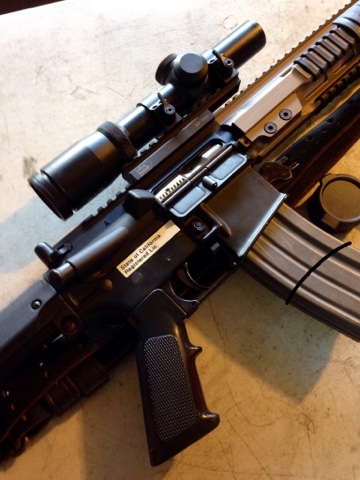
This was the kit I brought to team practice to try out for the Coalinga Rifle Club rattle battle team.  Two teams are picked to shoot the National Team Infantry Trophy (NTIT) match at the U.S. Nationals at Camp Perry, Ohio.  The teams must shoot in synchrony so that coaches can drive them like an orchestra in the wind.  "All guns left or right half-a-minute of angle" is the difference between winning and having a jolly walk.

Until this year, the gun of guns for this was the match modified M-16A2/AR-15 with 1/4x1/4 moa sights that clicked with the precision of a micrometer.  The arrival of scoped service rifles in 2016 changed the game.  Scopes offer several advantages.  My aimpoint with the scope was the head of the silhouettes with impacts offset into center mass offering the potential for very precise grouping, nice clusters.  


I brought one of these scoped guns with a Pride-Fowler 1.25-4X optic to team practice.  It's a very good scope that drives well.  It drove like a dream during zeroing exercises delivering said "nice clusters".  But the wind calls were off, as in left or right of the target off at times.   At the 100-yard tests I'd done prior to heading to Coalinga, the system drove well enough.  Elevation come up checks on steel were good too.  And the turrets dialed repeatably coming back to baseline zero again and again.   But at team practice, a call for two minutes of change at 600 had me zig-zagging to either side of the target.

The question was asked, "Is that thing tracking?"  So I took the thing to the 100 yard range and shot a box test starting with centering the scope into the bull then running a constant aimpoint box turning the knobs 12 clicks = 6 moa nominal between each shot to build up a pattern.  This is not your benchrester's test; this is how you test a scope for knuckle dragging.


Next, take the target and spend some time in the hotel room with a ruler graphing and measuring.  Data is data.  In this case, the data said this particular scope tracks well in elevation but exhibits a widening of windage per click as elevation rises.   It's a perfect 1/2 moa per click at 100 yards but progressively grows to 1 moa per click by the time you get to 600 yards.  I'd been observing this anecdotally and having the numbers in front of me confirmed the sinking feeling in my stomach about the scope.

You cannot have a scope in rattle battle that cannot follow the coach's wind calls and 1 moa per click is just not tight enough for NTIT at the nationals level when your gun up against guys with 1/4 moa A2's that track to perfection.

I verified it the next day by making independent clicks to translate a 2 moa move call into a 2 click turret dial.  The 1 moa per click on what should have been 1/2 moa turrets tracked right on to my calculations.  Perfect correction on paper, confirmation that the scope won't work for rattle battle.  It is what it is.  I chose poorly.  I'm coaching one of the NTIT teams this year.  Shooting member will have to wait until next year.


On the plus side, it frees up my gun to swap in one of the new NighForce SR 's that's supposed to be coming my way to test for Camp Perry so I'll be able to get some data with it before going into the 2400 Aggregate during NRA week.  The guys using NF's were getting good tracking at practice an I expect the NF will not disappoint.  The rest of CMP week is no biggie, I'm shooting my old reliable White Oak A2.  Still my king of the hill.

None of this is to say that there's anything wrong with the PFI.  It's still a well thought out optic.  The turrets are perfectly repeatable and the built in ranging reticle makes this scope head and shoulders better than an ACOG by a lot.  It's an ideal hunting scope and day combat optic concept.  It just didn't have the 1/2 moa tracking precision across the course that you have to have to shoot nationals.   I'm going to put this scope on an M-4 type carbine and use it for 200-yard CMP Modern Military Rifle matches.  It'll clean plenty good enough.

Some other things I learned,

1. You need at least a 2 pound "wall" on your trigger for rattle battle.  Less than that and it's hard to feel the second stage as you reset from holding the trigger back between shots.  I was wasting shots by discharging while resetting; you're just moving more roughly with the hyperventilating and tighter sling tension to lay into the gun.  The Geissele typically comes with less than that from the factory.  Use a trigger gauge and turn the second stage up.  It doesn't matter what the total weight is; all you'll feel is the reset click and second stage wall.

2. The adjustable butt stock is the coolest thing ever for service rifle.  I'd say even cooler than being able to use an optic.  Being able to match the length of pull to the position is the best.  It just gets your eye where it needs to be and your center of gravity in a better place.

3.  I'm not totally sold on the bolt hold open levers.  Most of the time they're fine.  Sometimes they're not and the bolt won't stay open particularly when you pull the prep mag out.  I find myself saving, "Might be better to just reach over the scope to close this sucker."

Finally,

I did inform Pride-Fowler about the anomaly. The pulled several 1.25-4x scopes from their inventory antd tested them on a collimator.  They reported all of them tracked 1/2 moa per click over the elevation range and suspect this may be an issue specific to my scope.

Wednesday, April 20, 2016

Armed Crime Deterrence in Metropolitan America: Making the Patchwork More Transparent

This is not an article about the 2nd Amendment.  This is not an article about gun control.  This is an article about what we've lost track of because we've lost our perspective.

I’ve grown tired of positional arguments about guns.  I understand the emotional passions that surround them but I do not agree that satisfying those emotions has much bearing or merit on what’s right for making sound public policy when it comes to how firearms figure into managing public safety and crime deterrence in the United States.

At the core of the animus laden political debate about guns is how they affect crime deterrence in metropolitan America.  Yes there a hunters who live in metropolitan American.  They drive hours out of their way to target practice and hunt.  Outside of a firing range with a backstop built to withstand the pummeling of ammunition hitting at well over 1,500 foot-pounds of force, most pistol bullets have one-third that energy level, one does not discharge a high powered rifle within the city limits nor stalk deer browsing on the decorative plantings on your lawn, if you have a lawn.  Nope, the primary purpose of firearms in the metropolitan America is as a tool to deter, dissuade or thwart criminals on the one hand, and as a tool to commit crimes on the other.  Guns, being intimate objects don’t care on which side of the equation they are used.  Humans, being sentient beings, do care and do bear responsibilities to understand how these tools are part of their environment they live in regardless of whether they like them or not.

So once again, I step back and start to ask questions.  What factors should a police chief, a sheriff, a mayor, a city council member, a county supervisor, a state assembly person, a state senator, an attorney general, a governor, a U.S. Representative or a U.S. Senator really be taking into account when contemplating public policy about the cost-benefit economics of the role of firearms in metropolitan public safety?  What level of competence in looking at the issue objectively should the voting public expect and demand these officials demonstrate and explain cogently to them?   Certainly the people don't want civic leader that are bought and paid for drones of lobbyists whose agendas pivot on dividing communities into favored and despised camps.  No, that's not the kind of answer that's in the national interest.

The next logical question then becomes do public officials have any clue as to what the matrix of guns in in their area and how they fit into the crime deterrence equations really works in their respective jurisdictions?   Probably not.   Crime analysts certainly know that 98% to 99% of law enforcement in the United States happens because of voluntary compliance by people who view the laws they follow as reasonable.  Crime analysts also know that of a the small fraction of a population that does no obey the law only a tiny fraction of these, 1% to3%, demonstrate a dangerous propensity to violence that may necessitate the threat of lethal force to dissuade them or the use of lethal force to interdict them.  And don’t kid yourself with placebos and substitutes, the best technology we have at this time to do that at the moment a threat emerges is a gun.  Crime analysts also know that as metropolitan population density increases and we pack more people into the same square mile of living space, the probability of encountering someone with violent intent increases.  You can measure this stuff.  You can test it against crime statistics databases.  It bears out as what math people call highly correlated indicators; meaning, it’s probably true.

What public officials understand even less is what the actual firearms equipped resources within a community to deter, dissuade or interdict violent crime are.  In today's superficial America, governing objectivity has become obscured by the political dialog of lightning rod terms like “cold dead hands” or “ammosexuals” – we’ve all suffered the barrage of memes, tweets and anonymous comments that are the “gift(?)” of the Internet.

Getting back to reality, public officials know about some of the crime fighting resources.  For others, they are quite frankly oblivious to them.  This is not good.  What happens because of this imperfect assessment is that public policy – like most imperfect things – then over relies on what it knows and fails to use what is doesn’t see.

So that begs the question, “What specific items should public officials see as being part of their real hand of cards to play to manage public safety?   Having convinced myself that I was not satisfied with the status quo; naturally, I made a list.

The top of the list is of course the police force.  More specifically, the portion of the police force that is out on the street patrolling and looking for crime to stop.  When you look into it further, you find that only about one-third of the total number of sworn officers are on duty at a given time, an artifact of the job being a 24/7 shift work process.  Of the ones on duty, less than half are “in the field” doing things like patrol and traffic enforcement; the number of effective units gets cut even more if patrol deploys a fraction of their units in what are called Adam or 2-person units; a single officer car is called a Lincoln, as in lone officer, unit.   And that’s for police departments.  The fraction gets cut further for a sheriff’s department where portions of the staff are assigned to jail or court duties; it can be about half of the daily workload of a sheriff’s office.  There’s a reason it’s called a thin blue line.

That’s about where political analytics about armed intervention in crime management ends most of the time.

In my own surveys of U.S. cities, the purest model for reliance of a police force for public security is the City of New York where 34,000+ sworn officers protect and serve – some would belabor that description – a population of 8 million occupying 304 square miles.  This is the densest major metropolitan police per capita concentration in America.

In contrast, the cities of Los Angeles and Chicago have police forces one-third that size.   The latter two are more in line with the force to population ratios found in municipalities in most of America. This sizing equation may be cultural but is more likely an economically supportable capacity limit for most of urban America.

The New York exception case has always fascinated me because it’s also a city where the use of a firearm by almost anyone else to defend against violent crime is likely to cause more legal trouble for the defender than the perpetrator.  Many a borough resident I’ve met marvels at the thought that it’s legal for most of America to even touch a handgun without getting arrested west of the Hudson River. Their fascination about firearms is exceeded only by the Japanese I’ve met that visit California ranges by the tour bus load for the novelty chance to touch and fire a gun.  In New York, gun permits are few and far between.  They are the province of the connected; those elite enough to be worthy.   It’s very much an all-in faith in government crime management strategy.

Being as student of global stability, I've also studied how hard it is to change human behavior patterns that are shaped by past catastrophes – a sort of cultural PTSD if you will.  This aspect of regional behavior is crucial to understanding the interaction of warring parties in other parts of the world, I’ve often wondered if New York policing has evolved similarly.  In this case, I look back to how the British garrisoned New York during the Revolutionary War.  As the war turned into a siege, the British piled soldiers into the city carrying on a 18th century version of "stop and frisk" effectively turning the garrison into a open prison to quell dissent.  At the time, troops took their liberties with the populace; a form of terror meant to reinforce control.  The occupiers also handed out favors; another form of power reinforcing control that goes back to ancient times.  In the end, the King’s forces withdrew.  But this model of governance in force seems to echo on.  To be fair, the approach does work and the City of New York is a far safer place today than in was in the 1990’s when they brilliantly papered over the city’s problems with bumper stickers and commercials designed to instill more cultural pride.  But a legion of officers is a costly 1% policing solution.  Economically, too costly for 99% of the rest of America that shares neither the history living under an all-in governance model, and in fact is mostly repelled by such notions, nor the ability to spend up for such a model.

It used to be hard to argue that there were viable alternatives to the New York model.  What you mostly found were cities where the economics of big policing did not work lamenting that their departments were woefully too small.  And then of course, they were hit with the reality that there are competing municipal priorities like keeping pot holes filled, power, water and sewage systems running, and business, building and zoning permits managed.  One is quickly reminded that there is no free lunch in America, even if you are the government.

Then alternative models began to emerge.  First in the form of the “Every Home has a Gun” press coverage phenomenon legislated by a municipality called Kennesaw in Georgia.  Don’t get too hot under the collar about that one if you don’t like guns; just remember that even without such "encouragement" laws, 34% of U.S. households have at least one firearm in them.  Google it or ask Siri if you don't believe me.

Then came the “Stand Your Ground” movement emphasizing self-defense outside the home.  This movement’s been around enough now to collect information to show that it does have deterrent, dissuasion and interdiction properties and violent crime generally does decrease in metropolitan zones where it is implemented.  Don’t whine about it.  Learn to use the internet like your children do and use it to read up on the FBI crime statistics.  See for yourself there’s a growing body of evidence to demonstrate a negative correlation effect; that means more CCW’s results in lower violent crime rates.

So much for the political footballs.  There's more.

All along, and strangely ignored by government planners, there were also contributions by armed security guard forces.  These are organized in both limited scope uncoordinated law enforcement resources like campus police, metro police, et al.  There are also separately licensed and certified paid armed security guards used for things from commercial building protection to guarding armored cars.

Finally, for some reasons not on anyone's radar are owner defended businesses.  Things like shopkeepers (fixed point defenses) and cab drivers (mobile location defenses) keeping guns tucked away but ready to use.  If you scour media reports, it turns out they do a fair share of the real world encounters entering into armed combat with criminals.

That’s a lot more guns in circulation for defense in metropolitan America than simplistic low information propaganda will tell you.   From a public safety policy management perspective, this totality of arms kept and borne in circulation in a metropolitan community is not something to ignore selectively, it’s something to measure in totality and leverage upon.

Objectively, it’s important that public policy planners look at these components of the so-called “good guys” equation without tainting their analysis by dismissing what may be some of the most cost effective means to increase both the perception and reality of crime deterrence by the use of credible countermeasures in their communities.

No silly dilly, “kumbaya” is not a credible deterrent to that minuscule slice of miscreants in our midst who are already prohibited class individuals in illegal possession of a firearm with violent intent that know “their money” is in your purse or home that are on the prowl to see if you are today’s easy mark.  Statistically, you will come within 100 feet of at least one of them once each day every day in a metropolitan area.  Wake up and smell some coffee.  Get your nose out of that cell phone and pivot your head around and be aware of your surroundings so they pick someone else to accost; that’s the deter and dissuade part of self-defense.  Use it.

So how to leverage the totality of a community?  Is there a way to quantify the net effect of all these armed force elements into come cohesive picture Is there a tool public officials can use to bring together the data and see what the numbers say?  I believe there is and I’m building one.  Like I once built a model to expose which small banks were safe and sound to make the banking financial crisis more transparent for ordinary Americans – you may remember it as “Move Your Money” – I’m building another model that does what strategic analysts call a “net assessment” – bringing all the known and previously ignored factors together into an overall measurement.


From there, maybe real “common sense” can emerge.  Stay tuned.

Update 4/22/2016:
This is more than just an article, Click Here to explore my "Armed Crime Deterrence" computer model.

Sunday, March 13, 2016

Making a Fixed Parallax Scope Work for CMP/NRA Highpower


Updated:  23-March-2016

The CMP's 2016 Rule 6.1.1 allows for the use of optically sighted M-16/AR-15 rifles in service rifle competition.  The optics used must be commercially manufactured not exceeding 4.5X magnification.  While this specification allows for future improvements to equipment designs by the industry, early adopting competitors are limited in their choices.

Utopia vs. Reality

The ideal scope for the game per the 2016 rule would be a 1-4.5X scope with impeccably repeatable and exactly tracking 1/4 MOA turrets coupled with objective parallax adjustment and a Euro-style finger adjustable fine focus at the ocular that can stand up to thousands of rounds per year of firing cycles.  At present, only one commercially manufactured scope meets these criteria; it also costs more than the rifle.  All remaining commercially manufactured scopes are fixed parallax articles.  Within the fixed parallax field, some -but not all - higher priced commercial models provide the desired level of turret repeatability; that is, equal to the utterly solid performance of a competition 1/4x1/4 pinned A2 rear sight.  At the lowest price points, robustness becomes an issue.  Most of these name or store branded scopes are actually manufactured by wholesaler OEM's.  They were designed around light recreational use engineering specifications; a universe vastly different from the pounding competitors place on their equipment.  What may work for the shooter coming out to shoot half a dozen CMP 200-yard Games matches a year may not last through the early-season work up for someone pursuing distinguished or more.

My assessment of the present imperfection in available commercially manufactured optics options is that it is likely to persist.  When I was at the 2016 SHOT Show, I made a special effort to visit the scope makers - as did others - inquiring about currently available scope models and, more importantly, their appetite to invest in new models to address the highpower competition market.   The answers were discouraging.  Firstly, the highpower market is a small specialized use case, make that minuscule in terms of the return on investment mathematics; the scaling potential just isn't there for convincing companies to allocate precious research dollars.  Second, the engineering required to package an idealized scope is not trivial.  Most 1-4x optics on the market have 1/2 MOA or 2/10th's MIL click steps.  The reason is because the fineness of the threads necessary to accomplish the precision tracking to 1/4 MOA in a 4X and lower magnification optic delves into new areas of aerospace class micromachining technology.  The tech exists to be sure but getting it to the firing line is what the MBA in me would call a non-trivial capital investment decision. Third, the 2016 CMP Rule capping maximum magnification at 4.5X runs counter to where the much larger 3-gun and military trends in day optical requirements are headed.  As 3-gun matches continue to increase the degree of difficulty to keep pace with the skills exhibited by top competitors, some of whom also shoot in precision rifle matches, the desired maximum magnification range in these optics shifts to the 6 to 8 power range.  Similarly, more emphasis on engagement at distance by the military, extending soldier systems into the 600-800 meter range, also pushes answers to a 6 to 8 power range optical solution. Given these factors, my belief is that highpower competitors will have to cope with existing commercial offerings for some time.

So be it; so the equipment isn't perfect; it's still usable.  The mission becomes to figure out how to drive what we have to get the most out of it.

Regardless, I believe that for bringing in shooters new to highpower, a scoped service rifle is the new fastest path to an NRA Expert classification card.  At the club level, bring that 3-gun "tacticool" looking machine with its muzzle brake or that 16-inch 1-9 twist AR whatever carbine you bought in the last gun control panic with the cheapie optic you got with it. Any optic will work.  Every shooter will benefit.  Shoot 100-yd Reduced NRA matches until you earn Expert.  You'll learn loads about improving your marksmanship fundamentals that will pay off in confidence and competitiveness in whatever other discipline you shoot.  Most people skip over this fundamental building block when first getting into shooting.  The CMP's 2016 rule innovation, with reasonable leeway by club match directors, opens the door for many, many people to pick up this essential building block without having to invest in any new equipment.  I'd encourage the entire shooting community to take a crack at it.

With that, here are my personal driving notes so far on using scopes on top of a service rifle,

Slow Fire Offhand 

Really, really, really trust your wobble.  Don't bother to dial your optic down to 1 power for offhand.  For all intents and purposes, a fixed 4X scope is probably just as good for this game.  After some experimenting, I found that keeping the scope at 4X and focusing on the reticle is what works for me.  The target will wiggle around as you wobble.  That wobble was always there even with iron sights; you just could not see it before and it's plain as day to see now.  It's like having one of those really expensive SCATT trainers the smallbore/Olympic guys use to train to reduce their wobble except, there it is, giggling at you in offhand.  Don't let the fact that you can see it now phase you.  Just focus on the reticle, relax into minimal movement as you let your NPA (natural point of aim) do the work of centering things up, squeeze with the best trigger discipline you can muster and crack it when your "chi" says TEN!  The results are delightful when it comes together and instructive when they don't.  Tickle yourself with this, an X in a highpower SR target is like hitting the letter A embossed in the A zone one or two football fields away ... standing.

Rapid Fire Sitting and Prone

This is where these scope truly shine in my opinion.  The full distances of 200 and 300 yards are well within the envelope of the factory pre-set parallax of most - if not all - scopes on the market regardless of price.  Turret movement to go from 200 to 300, if you choose to dial for it is 2 to 3 minutes - 4 to 6 clicks with a 1/2 MOA scope - at most depending on what ammo you are using so there are no issues with tracking accuracy.  Again, focus on the reticle not the target.  This actually requires mental discipline particularly with higher grade optics because the target looks so pretty in the image.  Ignore it.  This is instrument flying.  Keep your eye on the gauges.  There are some advantages with an optic.  You are impervious to light changes on the target; just hold center.  You can see coming to center as you breathe between shots better too.  With 4X magnification, if you had the discipline, you could shade for wind driving the reticle within the target's center; but if you have good repeatable turrets, dial the wind at 300 the same way you would your A2 sights. Just remember that those scope turrets turn opposite to how all U.S. service rifle sight knobs turn.  Irons drive like steering wheels; turn left to move left, right to move right.  Scopes are like bottle caps; screw in to move left, unscrew to move right.   Please remember to laugh at yourself every time you turn the wrong way at a match until you get the hang of it.  It's part of the apprenticeship process to fire a perfect tight group into the 7 ring because you dialed the wrong way.  Welcome to highpower!

600 Yards

Yeah, parallax is a problem.  The scope makers can talk about the minimal effects of optical specifications all they want but the fact of the matter is that shooter variables such as head position behind the eye box of a scope with an objective lens 500 yards out of alignment means a shooter has a lot more to get right every shot than an iron sights gunner at 600 yards.  Where the A2 shooter has the advantage of a two point of reference sighting system to manage sight alignment  - remember that being one of the axioms of making a good shot in the "litany of fear" drilled into all of us? - the scope shooter has only the single plane of the optic.  This is why parallax adjustment is so important as any smallbore, midrange or long range shooter knows.  You need to get the parallax matched to the distance to make the ocular eye box more tolerant of eye placement errors behind the optic.  If the parralax setting is off, get the position ever so slightly wrong and even the best shooters on the planet will fire corner pocket 7's and 8's at 600.

Sight Alignment

But, there are no reasonably priced 1-4X tubes with objective parallax on the market.  What to do?  The answer might be to create a sight alignment method for fixed parallax optics.  Huh?  This flies in the face of how you want to set up a "combat" optic on a gun for speed and ease of use but bear with me and ponder this.

Consider mounting the optic not at full eye relief to see a perfectly clear picture when mounting the scope but a little closer to your eye so that in prone there will be a shadow that forms if you are not perfectly centered behind the optic.  Center up to manage the shadow kind of the same way you'd keep rings of white with an aperture sight.  Voila!  Sight alignment!

Note that 600 yards slow prone is the only position you "need" this for.  Your head will be tilted a little bit more forward in prone than in standing or sitting.  If you have a collapsible butt stock, using one of the shorter length of pull notches might do the trick to get you in the zone if the standard A2 rear stock doesn't suffice.  The MagPul UBR has screw in pre-sets; might be handy for this.  You can get more rear weight in the A2 butt though and that may or may not be a consideration to you now that the 11.5 pound weight limit thing is no more.

If you use the same rifle for 3-gun, you want - make that need - a full eye relief placement of the optic when you mount the gun rapidly in that discipline.  A quick detaching base where you can reposition the scope a notch or two back for highpower shooting may be your salvation to create a dual-purpose "crossover" gun.  The best ones on the market go on and off quite well.  Probably best to use a zero degree mount so you don't induce angular shifts when moving fore and aft on the receiver rail.  Remember you are still working within the very short baseline of sight axis to bore axis and tiny changes mean boatloads down range.  Less is more.

Is this a perfect engineering solution?  No, it's coping with what we've got.  But if it works for you ... hammer it!  Nothing says we cannot use innovations in technique to overcome equipment limitations until something better comes along.  We're Americans; that's what we do.

Update on 23-March-2016

Reports are beginning to come back that the "sight alignment" trick works with fixed parallax scopes to get the gear to work at 600 yards slow prone.  People are moving both closer to and further away from the scope eyepieces to create the shadow that they are using to create their alignment halos.  Observing people on the line, it looks to me to be around 1/2" of movement different from where they say they normally place their heads on an A2.

All the people I have personally observed so far move their heads.  One person I talked to told me they intended to keep their body in the same spot and move the scope base forward of backward on the picatinny rail.  I suspect more people will to this later on after they become comfortable with how they want to shoot the halo.  One late addition to the sight alignment came in on the morning of the 24th.  This shooter says he drilled a 1/8th inch hole in the scope cap.  I hadn't thought of that one.

This finding is significant.  It means that any scope that has decent glass and repeatable turrets can be made to work for highpower service rifle competition.  This opens up a much broader selection of optics that can get people on the line.  This finding is also significant in that it verifies that a scope with objective parallax adjustment will indeed be much more forgiving of head position movement.  This will probably be an equipment separator in the future that could make a difference in what works easiest to win.

Epilogue

This article is a work in progress.  The incorporation of any new technology into a competitive environment always takes learning curves in unanticipated directions.  When I first heard of this pending rule in 2015, what intrigued me most was to see where it would go.  As I learn more, I'll continue to chronicle.  This story to me is the next chapter in a long book of service rifles that comes after the one headlined, "'Matty Mattel' Pop Gun Displaces Thundering Herd of NM M-1's and M-14's".

Thursday, October 01, 2015

Creative Tax Legislation as a Way to Improve America's Public Safety, Gun Safety and Create Funds to Invest in Improving Mental Health Care

When old ways stop working, it's time to explore new ones.

On October 1, 2015 following another active shooter incident in Oregon, President Obama called for legislation and politics.  Something to break the status quo that has made what should be rare incidents "routine".  So what kind of gun legislation might work?  What's something new? Something that isn't a placebo?  Something that isn't a lobbyist's fundraising story line?  Something that isn't Orwellian propaganda?  Try this.

I'm becoming less and less able to swallow the notion that disarming America does anything more than make us easy meat for the killing.   But how do we turn things around?   How to we make America safer?  How do we ensure guns are used to gain actual improvements in crime reduction?   How to we create the money needed to invest in better preventive mental health care?  So I thought a little out of the box and it came to me.  It's time to use the tax system against those who's elitist policies are exposing us to excessive danger.  The free loaders who want all the benefits of a utopian society but won't lift a finger to help; or worse, belittle those who are so lowly and common to try to look out for themselves.

There should be a law!  It's the cry of the day.  And so lets try a little mental exercise shall we?

Let's say we respect the Second Amendment.  This is a fair enough universal assumption as both the National Rifle Association and Moms Demand Action say they do.  Let's further say we want guns in good, well trained hands in America.   And let's say we want to gain control over criminal elements that impede our pursuit of life, liberty and happiness.   Let's add to this that we want to finally do something to invest in actually having the means to take proper care of our at-risk mentally ill.  Well and good.  All noble goals.

What if we legislated a tax that charged those who refuse to be part of the common defense a fee to opt out of being part of the working defense of the nation's domestic tranquility.   So people could pay a fee to opt out, freeload and enjoy the best of life in America by paying for the movie ticket.

How about we use that tax to fund national training programs for gun owners so that they will be more effective CCW permit holders?   Let's say forty-five percent (45%) of that tax base goes to it. We would quickly have a county as skilled and prepared as the Swiss.   To ease the transition from the society model we now have where citizens are wards - some would say inmates in a prison with no walls -   we allocate five percent (5%) of these taxes will go to training programs to teach law enforcement to work in better partnership with a population of armed citizens.

Both of these fund pools would be allocated to state and local programs on needs basis; basically, the training monies to where there are gun owning populations.  To ensure these benefits are nationwide, accompany laws enshrining national CCW reciprocity would quickly spread the benefits of such a process to even the most anti-gun communities.

And here's the kicker.  To reinvigorate our dismal mental health system, 50% of the taxes base collected under such a law would go to fund mental health programs and facilities to improve the nation's care for at risk mentally ill persons.  This a badly need by the nation and we have a dismal record at filling this social good need.   This type of tax would finally force our hand to be the helping hand it needed to be all along.

The tax could also be used to encourage more people to participate in active community safety instead of buying it via using a tax deduction or exemption.  To qualify for the tax exemption a person would have to attest that they are a gun owner and provide a form of evidence that they currently practice with their firearm as hunters, competitors or CCW holders.  This attestation mandates the creation of a public/private confidentially verified firearms qualifications database that will augment and improve NICS.  Presto, you have your improved level of gun training and de facto register of qualified gun owners; and it's a net economic positive recognition of public good value and essentiality for gun owners instead of a vindictive repudiation of their very valid contributions to public safety that elitists seem to need to make them feel better about themselves.

The above is a national tax concept best implemented in the tax code as a federal income tax buried within the tax tables.  The discounting on the tax would be structured as an exemption.   States could do something similar probably using a state income tax approach.  The scheme does not make sense to use sales, use or property taxes because these would not necessarily reach the non-gun owners who should be paying for the benefits being created through the efforts of others.

Roll this around in your head.  It's thinking outside the box to be sure but at this point with Columbine repetitions becoming regular coverage in the news cycles, perhaps it's time to be thinking outside the box.  We all need to be part of a new solution set. If the problem is this big - and I believe it is - we need to invest.  It makes lots of sense to consider a purpose dedicated tax to enable the system to improve.  It seems to me that those who refuse to lower themselves to the level of commoners to help keep America peaceful and safe should be paying for this public good in their tax bills.  It certainly seems a topic worthy of consideration by Congress and the White House.

Tuesday, December 16, 2014

Up Gunning the SKS: The Shernic Bullpup Stock andPride-FowlerRR-Evolution BLK Optic


One of my pet thoughts is that many older firearms designs are often underestimated by the fads of the moment.  One should bear in mind that the designers of weapons did the best they could to come with a tool that would get a job done; for the designers of military weapons, that job could very well have meant the very survival of their country's way of life.  In my early career as a military analyst I always respected the way the mission dictated the machines.   I think it's fun to learn to understand what the strengths and limitations of the solutions they came up with were; because they are so instructive about what solutions would be needed tomorrow.

A Proud History

The SKS-45.  This one's a Chinese Type 56. One of the many that entered the U.S. in the 1980's


The Samozaryadnyj Karabinsistemy Simonova or SKS was originally designed as a closing engagement weapon for the infantry element of mobile tank armies.  In this role, foot troops were in the role of security for tanks and not fully committed until the end game of an attack.  It was a solution designed to compete with the threat of the other massive mobile tank army that fought the Soviets, the armies of Nazi Germany.  It competed in this mission role with the very similar German Stg 44 and, in the USSR, gave way after the war to the AK-47.  It is a 500 meter and under battle envelope system who's concept carries on today in, among other things, the U.S. M-4 version of the M-16 series weapons system.

The SKS did not serve in the Soviet armies for very long.  It proved more susceptible to dirt than the AK-47 but, like so many rifles of it's time, soldiered on being supplied to and manufactured by allies and client states in massive numbers.

The SKS is today considered to be somewhat of a "poor man's" rifle.  They were rare in the 1960's with just a few samples making their way to the United States as Southeast Asian war trophies. Following the end of the Vietnam War, as America knew it, in 1975, a rather odd period of animus broke out between the Vietnamese and Chinese.  The Chinese realized that their southern neighbor and Russian ally now had the most technologically advanced tank army on the Asian mainland since the Imperial Japanese Army of World War II.  For a time, age old regional tensions dating from the age of iron escalated enough that the Chinese began to stockpile weapons on their southern frontier.

Eventually these tensions subsided and the era of economic trade with the West began.  In the late 1980's, one of the things the new breed of Chinese entrepreneurs began to ship to America were SKS semi-automatic rifles.  They sent them in such quantity at prices so low that US manufacturers began to clamor for import controls.  Later on, after the end of the Cold War, SKS's from Warsaw Pact and former Soviet war reserve arsenals began to arrive as well.  They remain low priced semi-automatic alternatives to the .30-30 Winchester for short range hunting and a good value solutions versus the late-comer .300 AAC Blackout rifles that fire a cartridge ballistically identical to the 7.92x39mm Soviet.  If you really want to, you can even make a subsonic 7.62x39mm round using pistol powders in charge weights in the .45 ACP range and heavy .303 British weight 0.311" bullets; that's pretty much all a subsonic .300 AAC Blackout is.  In guns, there's no such thing as magic but you sometimes have to pick up an old musty reloading manual to find the potion recipes.


Up Gunning the SKS

A Yugo SKS with an as-issued fixed magazine repackaged into a bullpup stock configuration.

The main weakness of the SKS and it's AK-47 cousin versus the M-16 systems platform is perceived accuracy potential.  The accuracy potential is actually there but you have to make some changes to the packaging of the gun.  Several years ago, I experimented with this with an iron sight solution for the SKS and found out that the spring held rear sight is to blame for the SKS's meandering behavior reputation.  The rear sight can move as much as 6 to 8 MOA side-to-side randomly as the gun is fired. That is greater movement than the width of a standard bullseye.  It's literally pointing at a different place shot to shot.  Changing the sight system to a less jittery one reveals the rifle can hold between 1 to 2 MOA or about the same as a rack-grade M-1 Garand.  That should not be surprising given that both rifles are military designs from the same battlefield era.  The axiom that mission drives engineering remains intact.

Better sights do wonders for the SKS but until recently, getting an optical sight mounted on an SKS has been rather problematic.  Solid durable bases suitable for current generation rifle scopes that do not lose zero and still allow proper dis-assembly for maintenance had been missing from the market. This is now beginning to be addressed.  Firms like RPC in Texas have begun to market replacement receiver covers with Picatinny rails that tie solidly into the action. These solutions work well but they do raise sight height above bore line.  You should plan to put the SKS into an aftermarket stock designed to provide good cheek weld with an optic if you go this path.

Another firm that has tackled the systems solutions problem is Shernic Gun Works in Alhambra, CA with their Bullpup Stock solution.  The assembled SKS reminds one of a .30 caliber Tavor. The trigger linkage mechanism delivers similar feel to the original donor rifle. It allows for stripper clip loading which is great if you elect to keep the original 10-round military magazine. And it has a top rail for mounting pretty much any sight system you'd also care to mount.

Note the gun is now an inline barrel configuration similar to the M-16, Steyr AUG, FN 2000, FAMAS, Tavor, et al.  The trigger operates via a linkage connected to the orginal trigger.  Sighs are mounted around 2.75" above bore axis, same as the M-16 series system.  Rails allow use of a bipod creating a compact and stable firing solution.

The SKS sits snugly in the bullpup stock.  The scope rail top cover joins to the stock via eight mating screws.

The trigger linkage is ingenious and when properly adjusted feels pretty close to the original trigger which, while it doesn't come even close to what can be done with an AR-15, is still manageable enough to deliver good shots.
This particular Bullpup rifle has an SKS with a fixed 10 round magazine in it that can be fed by SKS stripper clips.  The stock cover removes with one pin then allowing removal of the SKS receiver cover and easy access to clean the barrel inserting brushes and patches from the breech.   Most of the other scope mounting designs are not as convenient for accomplishing field maintenance.


This gun installed in this stock is a Yugoslavian model.  They are more prone to gas leak short stroking than the simpler and more robust Chinese variant.  Replacing the gas cutoff plug helps as this part takes the brunt of the erosion coming out of the barrel hole.  Surplus guns have seen a lot of hot gas.  Greasing the piston grooves helps too.  The concept is much the same as lubricating the gas rings on an AR to help keep the seal to function the action. 

The Shernic product does have some quirks at this stage in its development.   The Picatinny rail on the top piece is comes out of a mold that, due to heat shinkage, is about 0.030" narrow of a military specification rail.   It's a bit loose which is not good for accuracy.  Fortunately 3/100th's of an inch is easily shimmed.   Shernic does have plans to build a new mold in the future that will produce mil-spec rails but currently recommends using a shim made from cut up plastic gift cards to establish firm contact for mounted optics.  I found three or four layers of masking tape work too at which point you've got a solid mount.   Because the stock's rail is made from plastic, I recommend using a 1/2" aluminum riser to build a more durable rail to attach the scope rings to.  You have to do it anyway because a riser is required with most in-line - meaning the barrel is in line with the shoulder - stock designs.

The Shernic design is a work in progress.  This image shows the use of layers of masking tape to build up material to make up for an 0.030" too thin top rail due to plastic shrinkage tolerances in the mold.  The company has made incremental improvements to the design in the past and says it plans to offer a replacement mil-spec rail top cover in the future. 

Optics: Let's go All the Way to a Ballistic Compensating Reticle

As I said earlier, the 7.62x39mm cartridge is the ballistic twin of rounds like the .30-30 Winchester and .300 AAC Blackout.   The numbers tell the story.  From zero to 600 yards, a modern ballistic compensating scope with an etched reticle for the .300 Blackout supersonic rounds will be within 1 MOA of point of aim; that's within 6 inches point of impact holding on the same aim point for either round out to 600 yards.

.300 AAC Blackout7.62x39 mm
RangeVelocity, fpsDrop, MOAVelocity, fpsDrop, MOA
02260024000
1002068+3.062142+2.80
2001886018890
3001715-4.141657-4.05
4001558-9.041451-9.12
5001415-14.721278-15.33
6001237-21.261146-22.85

It turns out there is such a scope available.  The people at Pride-Fowler Industries released a .300 Blackout 1.25-4X first-focal plane etched reticle optic just over a year ago that sells for about $350.00.  I'd taken a look at a 7.62/.5.56 NATO version of scopes from the same OEM factory source when they came out and mentioned I had this SKS Bullpup Tavor'ish thing I had put an old Weaver El Paso K3 with a post reticle on and was having fun with to John Pride.  He said "well that's really interesting" and then a package showed up with one of these PFI Blackout scopes in it with a hand written note saying "Give this a try and tell me if it works."

The Pride-Fowler RR-Evolution BLK mounted on the SKS.
And so off came the Weaver K3.  I digress to report it did not wind up in some junk box but instead went on a Lee-Enfield No.4 Mk1(T) sniper rifle clone to shoot a CMP Vintage Sniper match.   Back to the SKS,  When I first tested it I was disappointed in the performance.  I had attached the Weaver K3 using mounts that were narrower on their footing so they were solid with the Shernic stock's top rail but I used mil-spec Picatinny monts with the PFI scope.  That's how I discovered the undersized rail width and the need to shim later confirmed to me by Shernic Gun Works.

Left side view of the scope mounting showing the use of the 1/2" aluminum riser.  This raises the scope to the proper height for the eye with a straight line stock and provides a more durable metal versus plastic contact point to attach the rings.  In this photo, a PFI Combat Red Dot sight is also attached.  It's actually the most expensive thing in the photograph. :)
The scope works like other ammunition matched ballistic compensating such as the military's ACOG and RCO combat optics for the M-16 and PFI's RR-900 model for M-14 based Designated Marksman 7.62x51mm NATO and the PFI/US Optics collaboration 1-6X scope designed for the FN-SCAR also in 7.62x51mm NATO.  All of these scopes incorporate both target range estimation and ballistic holdover compensation into their etched glass reticles.  Most are based on the flight curve of NATO specification ammunition which is remarkably the same for both the 5.56x45mm and 7.62x51mm ammunition.  STANAG standards equals mission definition equals engineering performance remember?

The PFI BLK scope differs from the NATO spec scopes in that its etched ranging reticle traces the Soviet intermediate ammunition flight curve.  As far as I know, it's the only one available to the U.S. market that currently does.  That's significant because the 7.62x39mm and it's ballistic cousins represent a sizable under addressed market segment.  Just saying.

The PFI RR-Evolution BLK optic.  Notice it has both subsonic and supersonic range markers to the left and right of the vertical axis.   You use the supersonic marks with the 7.62x39mm Soviet round. 
Does it work?

You bet it does.  With the scope base now shimmed tight to the top piece,  I re-zeroed the scope for the 200 yard hack in the reticle on a 6"x 6" steel plate.  Then I leap frogged to a 12" x 12" target at 300 yards and refined the zero there while firing a checkpoint round now and then to affirm the 200 yard reticle mark still connected with its target.   Then out to another 16" x 20" plate at 600 yards holding on the 600 yard maker and making final elevation adjustments.   After that, firing sets of 200 --> 300 --> 600 shot sequences at will was easy as can be.

Give it a try.  The old SKS will surprise you with what it can do.

Note:  If you want to look them up,  Shernic Gun Works is at http://sgworks.com/  and  Pride-Fowler is at http://rapidreticle.com/

Wednesday, November 12, 2014

My Savage Beast

The Gun

When I was a young college student in the 1970's, I bought an old rifle out of a barrel.  It was a Lee-Enfield No. 4 Mk1* made by Savage in 1942.  It was a sorry beater that had seen better days but I loved the feel of it.  I fed it cheap surplus .303 ammunition that smelled of rotten eggs and demanded cleaning immediately.  I never expected much out of it than to plink.  Eventually my exploring of the art of the rifle would lead me to other pastures and the old gun reigned as queen of the closet.


Lend-Lease "U.S. Property" stamp.

Then in 2005, the Civilian Marksmanship Program came to Camp Pendleton, California and hosted the Western Games.  Back in those days, all I had for the game was the M-1 Garand but it whet my appetite for more.  Over the next few years I bought an M1903A3 Springfield and started to ponder what to shoot for the Vintage Military Rifle class. The smart money told me to go for a Swedish Mauser in 6.5x55.  I actually started down that path but something deep inside hit me.  I owed this gun in the back of the safe a chance to shine in the sun.  Out came the Savage.  I started by shooting it at club matches. It had issues. The stock was loose. The rear sight was a folding leaf set for 300 yards.  The ammo I had was both corrosive and erratic.


Proof mark and not so proof mark.  DP means drill pattern; the kiss of death for a service rifle.  But this gun had a great barrel and it turned out that what was wrong with it was that somewhere it its life a too short mismatching numbered bolt body wound up in the gun.  Replacing the bolt body with a longer one got it to headspace with SAAMI gauges with a size "0" bolt head.  It may not last forever but I have it feeling it'll be tight a good long time.

The conventional wisdom about Lee-Enfields in competition said let it go and learn Swedish.  The gun has a DP stamp on the action which means Drill Pattern.  It had been rejected from service at one point and obviously resurrected of sorts by the gunsmith at the shop that had put it in that cheap deals barrel in the 1970's. Fine. Whatever. I was determined to get the gun to win a medal.  But there was one thing it had going for it that meant everything.  The barrel of the gun was in superior shape and had the most magical "goodness" to be wanted in a Lee-Enfield, a throat that provided good two point contact for a boat tail hollow point bullet between the case mouth and the rifling verified using a Stoney Point gauge.  I know accuracy potential when I smell it.  I spent the money and fitted a replacement stock set from Numrich.  I learned about, ordered and fitted a longer size "L" buttstock. I changed the rear sight.  I got commercial Remington brass and stocked up on 174 gr. Sierra Match Kings.

In 2009, I took it to Phoenix, Arizona's Ben Avery Shooting Complex where the CMP Western Games had moved to.  Things didn't quite go as planned.  I learned that guns with no windage adjustment are rather hard to shoot precisely in the wind.  But all that really did was make it so now I really wanted that medal.  A hiatus from shooting because I owned a bank risk ratings company and some fool blew up the banking system in 2008 meant I wouldn't bring the Enfield to Western Games again until 2013.  I shot the gun occasionally.  I loaded up full-sized once fired Remington cases with 38.0 grains of H4895 under 174 SMK's and headed to Phoenix.  What ensued was an exercise in determination to finish the match.  The case heads began to separate; five of them completely and many more incipiently by the time I was done. I wrote a blog entry about it last year called ".303 Learning Curve".  You can read about it in the other blog post but the short story is an adventure in learning about Lee-Enfield headspace and lots of sight parts swapping later, the end result was a gun that printed tightly.  It's a tale as much about how miraculously helpful the worldwide community can be as it is about a year used to rethink and rebuild my approach to my gun.  I an forever grateful for all the help and advice I received from around the world.  I've undoubtedly spent more on this gun than I originally paid for it by a lot.  Fine. Whatever. Such it is when men obsess.


Testing the Savage at the Burbank Rifle and Revolver Club in Castaic, California swapping front sight blades until it shoots into the 10-ring with a comfortable sight picture with the rear sight dial set at 200 yards.  Notice the 2013 trigger weighing inspection tape around the trigger guard.

The Fodder

On to ammunition.  As documented in that previous blog about this gun, I've changed so much.  I abandoned almost all of my old dies except for the seater and wound up with a Redding body die and neck sizer for case preparation.  I use the body die sparingly.  Just enough to get clean feeding.  I went from a full size die - that causes case head separations - to a Lee Collet die - not enough neck tension - and finally to a Redding neck sizer die.  That's a mouthful and about the original purchase price of the rifle in itself.  So be it. We're talking determination here.

One sentimental nuance.  After last year's debacle, a fellow shooter handed me two boxes of empty PPU brass.  I carefully sized and then fire formed this brass to the Savage's chamber.  I took these cases back to Ben Avery in 2014.  A fellow shooter's generosity also deserves its day in the sun.

The Savage No.4 Mk1* with the two boxes of PPU cases I was handed in 2013 in Phoenix.  A CMP GSM Course A match expends 35 rounds.  5 sighters, 10 slow prone, 10 rapid prone and 10 offhand all at 200-yards shooting at an NRA SR target.

A Redding body die, Redding neck sizer and Lee seater die are the new kit for making my .303 British competition ammunition.  Military cases have a thicker web and are much preferred versus the thinner U.S. commercial brass.
Cases sized and cleaned.  Notice that the shoulders are blown out from fire forming them to the rifle chamber.

Primed using Lee's excellent press top priming tool.  Yes that is a Lee Classic press with a three hole turret top.  I modified it this way because I have so many of the three hole turrets and I like that they aren't as crowded as the four hole ones.  It has a lot of power for sizing and it's very precise for seating.
Yes I throw my charges.  So do the big ammunition makers.  These second generation Lee Auto-Disk Powder measures with the elastomer wipers are amazingly consisted.  This one has a stacked double disk cavity and it is delivering 38.0 grains of H4985 in one drop.  Confirmations with an electronic scale say all is well.
The 174 grain Sierra Match King.


Another loaded round ready for the 2014 CMP Western Games in Phoenix, Arizona.
A tray of .303 British match ammunition in the making.

And then it's off to the races.  All triggers need to be weighed to make sure they make minimum weight. If you pass you get your yellow tape.  If you ever spot someone's rifle with this inspection tape in the trigger guard, it means the rifles been to one of the major competition tournaments.

2014 inspection completed.

The Day of Reckoning

So what happened?  Phoenix was as Phoenix is.  It was a sweltering, sunny day.  A mad dogs and Englishmen out in the noon day sun kind of day.  A day where one fills one's quart container with ice water, drinks it all and sweats it all out kind of day.  Well the gun and ammunition came through wonderfully. Rifle operation was smooth as silk. Sights dead on using a comfortable sight picture.  The ammunition fed like a charm, stayed together and shot tightly.

On the line at Ben Avery Range at the 2014 CMP Western Games cradling the rifle between shots.

The pure joy of working the bolt of a Lee-Enfield No.4 Mk1* that you've spent a lifetime with at a major U.S. rifle tournament is worth the journey to get there.

I love this picture taken by the CMP photographer.  It captures the complete focus and concentration at a rifle match; the very essence of first person competition.  It absorbs you into a bubble where it's just you, the gun and the target.  I've been doing it since I was nine years old and I would not trade the experience for the world.


And at long last, I met my goal that this old friend brought home its first CMP achievement medal.


The payoff.  How fleeting this moment that has so much meaning.  That is world champion Gary Anderson presenting my my Bronze CMP Western Games Vintage Military Rifle Achievement medal.  Great man from whom I have learned a lot.  It is a privilege to call him friend. 
This was a hard won trinket.  It means a lot to that young college student that lives inside me that bought that cheap rifle so long ago.  Best piece of bronze I've even acquired.  I was walking on air.

The Savage No.4 Mk1* with its medal.

What's next?  The progression of CMP achievement goes bronze, silver, gold and wood.  Wood meaning winning the overall match and getting a plaque.  We'll see how far this goes.