Sunday, March 03, 2013

Do Ten Round Magazine Limits Make Technical Sense?


I’ve been pondering the assertion that legislative proposals circulating in Congress and in many State legislatures make regarding limiting the size of ammunition magazines.  The fear cited most often to justify such legislation is that a gunman gone mad could expend massive amounts of ammunition quickly, reloading over and over again spraying lead indiscriminately.  Proposals run from restricting the future sale of such devices to outright criminalization of the possession including those presently legally owned.

There is of course no disagreement that an “active shooter” attack – that’s what these incidents are called in police parlance – is an undesirable criminal situation to be sure.  They are destructive episodes that disrupt the very fabric of society leading to all manner of proposals to solve or avoid the problem in the future.   Some proposals are prudent and urgent. Others are political and outlandish.  Still others start off sounding sensible but ultimately prove to be placebos or worse, have undesirable consequences.  The great task of course is to sort things out.

It is firstly important to ask what is the likely effect of a limited capacity?  Can one say it means someone can no longer spray bullets indiscriminately?  Probably it does not.  Some therefore say that in the future firearms should be, by design, slower to reload.   Will that work? Probably no. People who carry arms for both good and bad purposes will adapt.  The argument against the notion that technical features limit lethality is a false one.   Proof of it comes from the 19th century in the days of the percussion cap revolver, a gun that held only a limited number of shots and was slow to reload.  The solution was to carry two of them.  There’s no reason to believe it will not be the case in the 21st century.  It’s already common practice.  Police officers carry a back up gun precisely around the notion that the fastest reload is another full firearm.  The bottom line is that regardless of the law, a determined gunman will still very likely have 30 to 50 rounds of firing capacity – remember this number -- even in the unlikely event that he or she complies fully with such laws.  And I have to ask in all honesty, what psychopath planning an attack would do so?

Ok so much for criminals.  The next question the begs asking is, “Is there is a need from more than ten rounds of magazine capacity by legitimate users of firearms defending themselves?”  We’ve all heard the assertion by Senator Diane Feinstein that a five shot .38 Special revolver is all anyone might ever need.  Is this assertion in fact valid?

There’s an adage well worth bearing in mind.  It goes along the line, “If you go to a gunfight, bring enough gun.”  To garner a technical answer to how much is enough we need to delve into the physical realities of wound trauma and marksmanship under stress. Punditry aside, a gun works no differently than a club in a fight.  The object is to inflict sufficient trauma to cause your assailant to stop the attack.  Reliably stopping an opponent with a firearm takes imparting a cumulative 400 to 500 foot-pounds of energy into the vital zone of the target.  This means hitting a truly incapacitating body part and not just something peripheral.   When training police officers, the emphasis of the training is to deliver two to three shots into the vitals, I’ll spare you the list of what constitutes vital.  This works out to at least two hits in the case of modern ammunition most commonly encountered in police use such as the 9mm +P*, .40 S&W and .45 ACP with hollow point bullets and at least three in the case of older, less capable ammunition technology* designs in these same calibers.

Some departments emphasize training in combat marksmanship to accurately accomplish the task.  Even allowing for one extra shot for good measure, at accomplished skill levels, this means an operator can apply lethal force, make an assessment, and apply a second string of lethal force if need and have an ever so small reserve of ammunition left in a 10 round magazine.  That’s a pretty thin margin that does not account for the possibility to multiple assailants or the need to immediately transition to the much more difficult headshot if the threat reveals to be wearing body armor, all are very real dangers to police and civilians alike.

Police departments have long since standardized around service pistols with 15 or more round magazines because these sidearm deigns better address the margin of performance a defensive shooting incident is likely to encompass before having to reload.  A police officer typically carries two additional magazines for a total of forty-six rounds at the ready, that’s one in the chamber and 45 more rounds in the three magazines.  Note that police officers qualified to carry lower magazine capacity side arms carry just as much ammunition.  They have more magazines on their person.  Remember that number from earlier in the article?  It’s a planning factor for combat readiness. It’s a constant figure of merit that will not change.

Let’s return to the 10 round magazines and the high premium they place on marksmanship under stress.  It is costly both in terms of dedication and budget to train all officers to such levels of marksmanship.  The reality is that not all officers are good shots.   Some police department policies account for this by training around a volume of fire approach to get to the required number of vital zone hits when applying lethal force.  The trade off is calculable.  Gross error rates – one of those military effectiveness mathematics artifacts – typically estimate that a less than perfect marksman shooting under the stress of battle will land one out of every three rounds fired in the right spot.   So if one needs to make three vital zone hits, it’ll take about nine shots.   That’s one shot shy of running out of ammo with a 10 round magazine.

Actual cases show that an officer in a panic fire situation will tend to totally empty his or her gun and keep fingering the trigger even after the slide has locked back, a phenomenon seen in massive amounts of ammunition being expended in shootings.  For these officers, their side arms are often one burst application of lethal force weapons.  Not ideal by any measure.  Usually, they miss and the two bullets that find their mark and end the gunfight comes from the more skilled cop that applied lethal force correctly.

Restricting magazine capacities below 10 rounds turns the math into an even riskier game of gunfight luck.  In Cuomo country, the future average officer's 7 round magazine will yield a 70% to 80% chance of incapacitating the target.  Like the theoretical active shooter at the beginning of the article, you better believe an officer restricted to "politically correct" survival risks will be carrying a readily accessible back up gun at least equal in firepower to their primary service pistol.   Recall the active shooter from earlier in the article.  The symmetry of need is eerily pragmatic.  I think its not unrealistic to expect that departments and citizens will adapt with a renewed interest in marksmanship and the use of higher energy loadings like the .357 Magnum and its semi-auto equivalent the .357 Sig or even seriously powerful rounds like the .41 Magnum and .44 Magnum that were being explored 50 years ago before the advent  of the "Wonder Nine" pistol in the 1970's.

So let’s look at that 5-shot .38 Special revolver assertion again.  The .38 Special cartridges deliver much less energy per round than the loads enumerated earlier in the article.  One needs to place at least three and preferably four rounds to approach the 400 ft-lb’s delivered into the vitals to end the gunfight.  It’s a far more difficult firearm to shoot accurately than a full size 15-shot service pistol; in fact, the snub nose revolver is an expert’s gun that even excellent marksmen work hard to master and maintain proficiency with.  A motivated civilian who trains reasonably will likely perform no better than a 1 good hit out of every 3 shots rate.  You might get two good hits in before the gun runs dry.  This means a person so limited probably has maybe a 50% probability of incapacitating an assailant to promptly stop a threat using a low capacity, slow to reload 5-shot .38 Special revolver.  That’s the math.  It is what it is.  No.  It is not enough gun.

The Need for Legislative Diligence

What this should tell legislators is there are technical reasons why guns have come to be configured how they are today.  These configurations are not arbitrary.  They are legitimate mission driven.  They can mean the difference between life and death for persons in need of defending themselves be they police officers or citizens.  Firearms have evolved continuously to fit the mission needs of police officers and citizens defending themselves against the same criminal threats.  Regardless of the rhetoric of politics, for handguns, their present configuration embodied in the 15 shot service pistol is what makes them a “credible threat” to potential criminals, a valuable tool for legitimate defense.

It seems to me that legislators should take more time to study and understand this complex balance.  Already we see the gun industry preparing to refuse to sell to law enforcement any tools that citizens cannot have, tools they need to be that thin blue line that augments the efforts of civilians in an America where 95% of law enforcement still happens because of voluntary compliance.  It is actually a very legitimate policy question for these manufacturers to ask what is the difference between a policeman and a civilian when it comes to their needs to resist a criminal threat.  They are acting like an NGO when they point out that the question is not just some some bargaining chip to create a separate privileged class of citizen to co-opt law enforcement to supporting a law in the same way other interest groups vie for advantaged privileges from a benevolent government.  Is a cop's life more valuable than his next door neighbors?  Is one less worthy of equal protection under the law?  How soon will it be before some zealous politician places the patrol officers in a jurisdiction in the awkward position of being under gunned?   Who will take the blame when one of their names is added to the roster of the FBI’s LEOKA* statistics?

Consequence Always Happens

So what criminal adaptation consequences might stem from changing America’s firearms so they cannot be employed efficiently in self-defense?  The most common criminal adaptation seen is a phenomenon called swarming, gangs of assailants who overwhelm the defender.  The technique is as old as conflict and the equations governing the risk-reward go back to the methods from the Age of Muscle of warfare.  Simply outnumber the capacity of the ill equipped defender to resist and you win.   In today’s America, the cost to try this is still mostly unbearably high for most criminal’s tastes because of the defensive potential of firearms.  Criminals, like all predators, follow the cardinal rule of predation.  Don’t get hurt.  They prefer victim-able prey.

We risk changing this balance inadvertently as we pursue a myopic focus on the matter of mass shooters, a group that has shown a remarkable propensity to apply the principles of predation to great effect particularly in selecting locations and moments where the risk of armed resistance is remote.  The perpetrators here seem to fit a definable set of mental instability profiles that are not insofar as I have seen the subject of urgent legislation to deal with them; that's a troubling thought of another kind.  


* The 9mm +P and +P+ ammunition is a version of the 9x19mm Parabellum round designed for use in modern pistols.  Propellant is loaded to pressures exceeding U.S. SAAMI specifications designed to protect older guns from excessive stresses.  Loaded with modern expanding bullets, these rounds perform equally with other civilian semi-automatic ammunition in common use by law enforcement when shots are placed in vital zones of a target.

* Older technology ammunition includes non-expanding ball ammunition that is much less effective at delivering incapacitating trauma even when hitting a vital area.   Geneva Convention compliant “ball” ammunition authorized for use in military side arms is of this lesser effective type.

* LEOKA stands for Law Enforcement Officers Killed or Assaulted, statistics compiled annually by the Federal Bureau of Investigation.


Tuesday, January 01, 2013

New Year's Eve "Belly Gunning"


I'm not really much of a prone shooter.   My competitive focus in the shooting sports tends towards Service Rifle -- the hunt for "leg points"  -- and tactical precision matches that help hone my understanding of unknown distance shooting.  But on New Year's Eve each year I take to my "belly" and assume the position to participate in the fine sport of Any/Any Mid-Range competition.  Truth be told, I do this more to have a day hanging out enjoying the company of friends and the heckling we subject each other to.  It is the music to my ears that a good New Year's Eve party should be.

It's usually bitter cold for these 600 yard matches.  It's the rainy season in what passes for winter in California.  2012 did not disappoint in the need to wear one's long undies and feather filled jackets.  It wouldn't be December 31st if one did not see gray skies and hear the crunching of ice under the tires driving into the range.  At 2,600 feet altitude in Southern California, there usually isn't snow.  What there is is freezing wind coming from the snow covered mountains chilling the air at a good 10 to 12 miles per hour.  Ice stays ice.  It adds to the ambiance and tests one's down filled clothing fashion sense; the more field savvy arrive in classic Filson's oil garb.

The gun rack is a multicolor display filled with Eliseo tube guns in a bright livery of color reminiscent of jelly beans.  This is the land of the NRA high-power rules compliant boomstick.   The tactical rifles with their recoil managing muzzle breaks and eye busy measuring reticle optics are left at home.   Plain ended barrels and simple crosshairs are what you need for this game.  Joining the gathering of tube guns here and there are the wooden stocked glass bedded rifles and this year even a Euro fantastic target rifle that costs more than a Toyota.

My gun of choice is a classic.  An old 1970's Winchester Model 70 target rifle originally made by one time US Team Captain gunsmith Creighton Audette in the hey day of these guns as the match rifle of choice.  I admired and envied those that had them when I was young and snagged mine about seven years ago from someone who had shot his example too little.  This particular rifle was purpose built to perform with surgical precision, a fact I have tested to be true numerous times seeing how easily one can pick which leg of the letter X to target at 200 yards and hit it with near perfect control.  It's been updated with an adjustable cheek piece by master sprinkler of competition rifle holy water, Doan Trevor.  Looking over Audette's handiwork, Doan also told me not to mess with the gun's perfectly lapped Hart barrel until, well, ever.  It now sports a 6-24X Vortex fine crosshair dot scope replacing the boat anchor heavy 15X Unertl Varmint that was its original 1970's topper, POSA bases and all.  Repeating, this is the better and cheaper Vortex not the so-called "tacticool" ones.  A Weaver T is the classic scope for this application where you set the knobs during the sighting shots and hold for wind the rest of the string.  A new set of irons with the latest adjustable everything's completes the ensemble for the compulsories of Regional or Palma matches.

The group I shoot with is smothered in High Masters who make simple work of shooting out the centers of the targets over and over.  Winning scores at these "club matches" run into the 599-40X.   My once per annum appearances put me in the lowly Expert class in the NRA competition divisions record keeping computers.  Still, I try to get better at it every time I shoot and my goal has always been to shoot a "walk on" Master score on New Year's Eve.

And so into this adventure I arrived with my gun and an ammo can of carefully hand loaded ammunition; your basic 168gr Sierra Match King over 44.5gr of Varget seated to 2.800 l.o.a. if you are curious.  I tend to like middle of the road rounds that deliver delightfully tiny standard deviations on the chronograph.  These particular ones said 6 fps when I tested them; yes that is an amazingly good batch.

Mid-Range matches at the Burbank Rifle and Revolver Club (BRRC) are a 60-shot 3x600 yard affair with each stage having unlimited sighters and 20 shots for record in a time limit of 30 minutes.   The objective is simple; put every bullet into a teacup sized X ring.   Complex wind patterns in the BRRC canyon invariably conspire to prevent this from happening.   It is normal for each wind flag to point in a different direction and for the mirage to agree with none of them; and it always shifts the moment you put your head down into the sights.  We call this "fun".

Stage one was COLD and shifty.  I hadn't fired this gun since testing the ammo in March and I wasn't sure if the scope was sitting at a 200 or 600 yard zero.  The elevation and windage knobs were at zero but the parallax knob was at 600.   The notebook containing the required information was of course sitting safely on the desk at my office where I had used it to transcribe data just before the last tactical match.  FML.  Adapt, overcome, prevail.  The first sighter shot impacting in the berm below the target but generally good on windage confirmed the BZO was the former so up we come 11 MOA to get on paper.  Bang.  The target comes down reassuringly and a shot spotter turns up in the lower quadrant of the paper where its supposed to.   Up 2 1/2 and left 2 MOA and we are in the 10 ring.  Left 2 clicks more and the X marker shows up.  Fire again to make sure the same hold and pressure on the stock goes in the same place.  Call for record.   Twenty rounds later and a few wind shifts that slipped by me I had a 189-5X on the score sheet.  Off comes the shooting coat and back on comes my down parka.  I'm happy.  That's not bad for a rifle I haven't fired in competition in over three years.

It's a four relay match so my next turn doesn't happen for another hour and a half.  I take another turn being line officer -- we trade the job around -- and use the time to gossip with the score keepers.  The topics range from the what's the best combination of base color and top coat to paint one's tube rifle so it will blind one's opponents utterly -- Gary Eliseo says a good choice is fuschia with metal flake with a clear coat to add depth but you'd better be shooting high master scores all the time to back it up -- all the way to getting tips from an 11 year old on how to win when playing "Call of Duty" online.  When you need to now about the art of the kill streak, ask  a pro.  Heckling centers around reminding service rifle shooters using optics that the knobs turn in the opposite directions and no amount of muttering Hogwarts spells under one's breath will change that.

My turn at stage two comes at last.  It's warmer now.  The sun is shining on the firing line and it really helps one's shooting.  Kumbaya!  I'm also now realizing that the work I've done all year to improve my slow prone shooting with the AR-15 in Across The Course matches combined with the gingerly sensitive holds one has to use to connect with smallish tactical rifle targets has remarkably positive influence on one's belly gunning potential.  I spend most of the time this string getting perfect NPA's and identical cheek tension on the gun.  The wind's picked up a minute but that also means it's shifting less so the hold off in the scope is much smaller.   The annoying part of this string is that I get about a half dozen duds rounds.  Noticeably light strikes.  Not sure why.  On my list to check the firing pin protrusion and cocking piece clearances.  Still, the guys remarked I never flinched on any of those duds.  I think that's a compliment.   Despite the annoyance, I'd managed a 194-8X for the string.

Back to running the line and bantering.  It's getting well into the afternoon and daylight is short in BRRC's canyon.  The targets go into shadow well before 4:00pm and I'm on the 4th and final relay so I'm beginning to think about shooting into a cold, dark tunnel.   The timeline does not waver from this prediction and when my turn at my firing point at last returns the 600 yard targets are in the full shadow of a New Year's Eve setting sun.  Thank goodness I'm shooting Any/Any with a big light gathering objective scope.  The preparation period rewards me with a good clear picture; the kind of light one hopes for waiting for the deer to meander by after a long day in a blind.   Sunset also means a pause in the wind and the flags are now wafting gently; the air swirling softly at around 2 miles per hour.   It's X count weather!  I switched to another box of ammo based on Lake City LR cases instead of the once fired Federals I had been using hoping the duds would not persist.  It was a good move.  First sighter 1 MOA to the right.  Correct windage.  Fire again and it's in the X.  Call for record.  The zen of a string of fire with perfect cadence staying in touch with the wind is like playing a perfect solo with a fine musical instrument.   It just feels right as 10's and X's slip effortlessly into the target.  Twenty rounds later I had shot a 196-11X not knowing or caring about it until after I had reinserted my empty chamber indicator and meandered over to look at the scoresheet.   Breaking the magic 50 percent X's is always the sign of being as one with the gun; something to smile about when it happens.

Tally for the day was a 579-24X; nowhere near enough to win around the BRRC crowd but that's still a 96.5% to go into my NRA Competition Division log records.  Yippee do!  I got my "walk on" Master score.  Not a bad way to end the year.  Certainly worth penning into a blog while enjoying a cup of coffee.

Happy New Year!

Thursday, December 27, 2012

As 2012 ends, now is the time for all good Americans to come to the aid of their country.


Freedom is about taking action.  Politics is about lobbying and the most powerful form of that is still "grassroots" action.

Now is the time to begin sending lawmakers letters and emails telling them that to prove that our nation truly does respect the Second Amendment, any new laws and regulations passed regarding firearms must include a provision recognizing the Right of every American citizen to always have access to the equipment necessary to participate in the one aspect of shooting that most closely reflects the   preservation of a well regulated militia as being necessary to the security of a free state, the promotion of practice with the current U.S. Service Rifle.

It is time we insist that the deliberation of our Nation's law mature beyond the specious argument that only sport or self-defense as sanctioned by a benevolent government are the determinants of what arms the citizenry.  This is false.  In its very notion it is a reversion to the People being subjects to the whimsy of the powerful; the very reason Colonists came to the Americas.  The very reason immigrants still come to this land.

It is time to remind ourselves that the body of the People remains the most powerful asset this Nation has.   That we should not be remiss and dismissive of so important a resource to the betterment of public safety as America's gun owners, the very people best equipped to aid in the furthering of a culture of safety and tranquility if only the rhetoric of politics could learn to go beyond seeing the People as pawns in a game of influence.   It is time to admit that if we truly want solutions that save lives, it makes no sense to cut off such an expansive and cost effective resource.  Partnership really is the only way to reach our objectives.  Always has been, always will be.

Make note in your respectful but stern admonitions that you and millions of other Americans now make it part of your test to see if government can still remember how important the basic tenets of this Nation are to its longevity far beyond whatever one moment in time challenges us with.  That We the People know our culture is still a baby in the lifetime of cultures.  If we lose our way, we will never make it to celebrate an eon.

Respectfully to my fellow citizens,
Dennis Santiago

Saturday, December 22, 2012

Wayne LaPierre, Bill Clinton and Manning the Ramparts

Also appears at,
http://www.huffingtonpost.com/dennis-santiago/wayne-lapierre-bill-clint_b_2352256.html

The acrimony of politics continues to get in the way of looking at public safety and mental health issues. That's not surprising. Christmas spirit -- yes I insist on calling it by its offensive religious overtone name -- seems to have deserted the United States this year giving way to a permanent siege of political angst.

So I have to laugh at the irony of the reaction to the NRA's call for more police in schools because it's exactly the recommendation that Bill Clinton made about the "Cops in Schools" initiative in the aftermath of Columbine. The more things change, the more things stay the same.

Here at last we have a net sum bipartisan recommendation and of course we reject it utterly. The United States proves once again that we are not so much interested in solutions as we are interested in soothing our need to express ourselves. Trumped by the love of snark yet again.

Let's explore the hyperbole though. Where does it take us?

My first reaction to the proposal was actually somewhat negative. Call me a traditionalist but I'm one of those people that just doesn't like living in a country where moving about in daily life is the equivalent of passing though a series of TSA checkpoints. May I see your papers please?   Combine that with Internet technology, RFID chips and eventually retina scans and we're living in a patchwork of green zones and outside the wire badlands in America. Not to mention -- since we are talking a about a federal level instant check future -- entire classes of people who will avoid the green grass on the other side of the FLOT. That's "forward line of troops" for those of you that did not learn military speak. Think this is nuts?  Go for a walkabout in Afghanistan.  We've already put that "tech" into action there and after the fiscal cliff the companies that make that stuff will be looking for a "new market" opportunity to peace dividend said technology.  Look in the nice machine before turning in your homework please.

Ok so having gotten my deepest "life, liberty and the pursuit of happiness" yearnings out of the way, onto the mechanics of the proposal.

Today's rhetoric -- like all myopic American arguments -- is about guarding the gates of schools; make that all schools, all the time. That's a lot of schools. But wait! Violent mass killing events have occurred outside of schools. They've occurred in movie theaters. They've occurred in parking lots. They've occurred on vacation islands; this last example admittedly did happen in Norway.  So multiply the size of the job by all the green zones, aka all the gun-free zones, that would need to be guarded in this new safety starts at the wire version of America.

Bear in mind that mass killers -- while mad as hatters -- are also resourceful when it comes to the predator vs. prey game that plays out in their heads as they emerge from obscurity to shock our senses with the unthinkable. Going down this path means closing more and more holes in the perimeter as time goes on. It just is.

A bigger government solution -- even an uncomfortable bed fellows bipartisan one -- is expensive. In a typical police department there'd be many officers assigned to a School Resource Officer bureau -- SRO is code for "cop on campus" -- as there are assigned to patrol, traffic or detectives. They'd get bored just sitting there so they'd likely be flitting between campuses. That sets up a false defensive posture because -- as any well-heeled threat knows -- you attack when the guards aren't on station.

It's helicopter warfare all over again. The U.S. track record isn't so good at this.  We lost the one we tried in the '60s and the issue remains in doubt with regards to our latest attempt.  So naturally, let's try it on ourselves and maybe we get it right this time.

Well you can't very well leave the no guard at the post security holes open; well maybe we can deny it until the first, second or third proof by death that a determined mad dog can still wreak carnage. This of course causes the old "village defense force" plan to activate. So we'll wind up arming the locals. We'll send them to powers of arrest and use of force classes. We'll issue them CCW licenses. We'll insist they practice their marksmanship and take "active shooter" scenario combat training classes. We'll breed and raise to the stature of respected citizen a new group of well-armed Americans.

And that's pretty much how the stoichiometry tends to go. Been that way on this planet since the Mayan calendar was first printed. Ok so now big government is happy.  The NRA is happy.  The "green zones" are safe.

But what, if anything, have we improved about life outside the wire? About the plight of the mentally ill still ignored. About the people who dare not approach the ramparts lest they be revealed as social undesirables and swept away in an Internet enabled checkpoint instant. They will still be there. They will still be suffering. We will not have done that much to reduce the probability or even the rate of people falling into the cracks of our utopia as we wait and dare the sick to come across the wire.

Somewhere in this discussion of how to make America a safer place for all, we still need to turn our attention to the fact that the world outside our comfort zone is still part of the United States; that these at-risk individuals and their families are still and always will be Americans.

I'm not against the line of thinking that Mr. LaPierre and President Clinton have espoused. The strategy has utility even given some inherent limitations. I just don't think it's a comprehensive enough investment in the future of a safer America.

Thursday, December 20, 2012

Reducing Gun Violence Must Ultimately Be a Partnership Between Government and Gun Owners


Also appears at,
http://www.huffingtonpost.com/dennis-santiago/reducing-gun-violence-mus_b_2340885.html

Sometimes you have to step back from horror to look for solutions to it.   In the United States, we have seen a pattern of violent behavior emerging for a number of years.  It's become "common" enough that "active shooter" scenario training is now part of the annual cycle of training of most police departments.   Like a piece of shock music, the location changes but the refrain is always the same.  Somehow, a mentally unstable person falls through a crack and acts out violently targeting victims who are easy prey.  The carnage is sensational and stuns the senses universally to the point that we all grasp at anything we can to help soothe our shock.

What is important to remember about the United States in such times is that though the individual responses are artifacts of a vast plurality of views on how to react, the universal commonality of the American People is we are not content to accept such losses as part of the status quo.  We seek the common outcome that our society be less susceptible and less vulnerable to such threats.   We do it noisily like a cacophonous horde wielding placards and pitch forks demanding something be done.   We look to government hoping it may have a panacea and bicker when it cannot deliver.

So I thought I try a different tact.  What if we challenged ourselves, like a huge collective non-government mass of humanity, to solve it.  What are the things we need to bear in mind to manage our expectations and guide our pragmatism?

So let's define a mission.  Let's posit that what we want is to find an immediately implementable set of actions that can tangibly reduce society's susceptibility and vulnerability to sudden emergence mass killing violence.

There are four points of interdiction that are available,
1. The available inventory of weaponry that a perpetrator might access.
2. The point of sale where a specific weapon passes from general inventory into individual possession.
3. The junction in the timeline where the at-risk person gains active control of the weapon to commit the crime.
4. The interdiction of the "active crime" itself to limit the extent of any damage done.

On the first point, guns are not going to go away in the United States for a variety of legitimate reasons.     The inventory of firearms in the United States is vast and it is overwhelmingly used for both recreational and defensive purposes.  There is a clear consensus emerging particularly among lawmakers that the Second Amendment of the Bill of Rights is real and has importance that goes beyond any single issue of the moment.   It was placed there to help stabilize and perpetuate the Union and no matter what anyone says it's doubtful that the country could survive without it.   Given this, we need to look at the remaining potential points of interdiction.

This gets us to point of sale controls.  Being pragmatic, this is government's most practical role in the process.   Access control at point of sale is about as good as it gets no matter how many laws are passed by Congress or activated by Executive Order.  It's where manufacturing licensing, eligibility rules, background checks, transfer processing infrastructure and pretty much everything else to do with buying and selling a gun takes place.   For each gun going from legal possessor to legal possessor, the bulk of government's apparatus starts and stop as the firearm is handed from seller to buyer.   From there on, the burden of control rests upon the individual gun owner.

Many people, including myself, are appalled at the inadequate state of the government's infrastructure with regards to managing this category of risk at the point of sale.   Mental health records in the present background system are full of holes you can drive a truck through.   Mental health care for severely ill persons is a national disgrace.   What else can you call a system where state run institutions are long gone, health care providers and their insurers more than anything else "wall off" these inconvenient individuals from the system.   In the meantime, individual families will remain forced to shoulder almost 100 percent of the burden of being care giver and watchdog of their troubled loved ones.

But given the magnitude of the systemic disaster we have perpetrated upon ourselves, mental health reform will not happen overnight.   It takes years to find the funding for, let alone settle upon the rules and train the people who would operate a new system of facilities where observation and treatment of severe risk individuals can be done.  Jails are not the answer.  It's wrong to punish sick people for being sick. Regardless, this is not an active path to a solution that will yield immediate widespread results in terms of lowering the number of mass killing incidents we will see in the next twelve months.

This gets us to interdiction point number three.

Once we get here, government is no longer the main gatekeeper.  It's now up to the individual legal gun owner to ensure that weapons in his or her custody do not pass into the control of an at risk person at the moment that person intends to commit a crime.  That's a very narrow but extremely mission critical circumstance in the overall universe of how people own, store and use firearms in this country.   So rare an event that we don't have very good rules of engagement about what people need do when they sense such a control junction is imminent.   It's narrow because the vast majority of gun owners will never encounter the problem.  It's the very small minority of gun owners who are in at-risk households that quite honestly need guidance and help.

That help has to come from other gun owners.   It's only other gun owners who are familiar with the concepts of firearms safety and the proper storage of firearms who have the necessary skill to assist at-risk households.   There are expectations that gun owners have of each other about making sure firearms and ammunition are kept separate except at one's assigned live firing point; and that designated firing point in a defensive posture could be on one's person.  Regardless, when the firearm is in condition to fire the expectation is that it is under the control and supervision of the legal possessor.

In an at-risk household, the legal owner has a heightened need to be learned of and ensure an elevated level of storage and control.  That means locks.  It could mean disabling everything except the defensive gun in use by taking parts out.  It could mean making and maintaining friendships with other trustworthy gun owners who can take custody of weaponry, when needed, to create additional physical distance safeguards.    People need those friendships to add to their support group for those times when the stress levels of care giving may be so high someone has to be there to let them know they are not alone and abandoned.  These measures -- and I'm sure others that will come to light as people focus on this -- are common sense prudence, require no government action other than positive encouragement, and can be done tomorrow to cause an immediate state change in the degree of danger posed by this type of threat.

Bolstering infrastructure admittedly takes money.   Some at-risk households may be financial impaired in being able to improve their risk management profile.   It's Christmas.  Not a bad time to buy a friend in need a safety present.   It's a good way create the kind of grass roots support groups this country needs.   I've been involved in such people to people solutions in the past and I continue to believe it is the true strength of the United States to overcome anything.

A quick side note about managing unintended consequence risks. I must point out that I am rather uncomfortable with non-gun owners who lack training being an integral part of in the field firearms management.  If one does not know the how's and why's of firearms, you're frankly not qualified.   Gun owners actually see details of procedure and have a culture of correcting each other that's a little hard on the egos of the uninitiated.  I'm very much of the opinion that while one does not have to own a gun to care about this public safety issue, there are minimum skills required and if you don't have them you'll likely do more harm than good.   America has plenty enough gun owners to implement a better form of interdiction point three once we have declared the national resolve to do so.  In the longer term, perhaps it may be prudent that even non-gun owners take the time to at least learn the skills so they can be better equipped to be part of the very one-on-one nature of this aspect of a national safety strategy.  But it's not a burden I would advocate forcing upon people.

Finally we get to interdiction point four.  In the last few days I have lost count of the number of off-the-cuff ideas I've seen on this.  The myth that gun free zones offer greater protection has suffered the "mark to model" failure the mathematics of operations research has always said it would.  It's been replaced by lively diatribe about arming teachers.  I've seen proposals for combat veterans to form guard companies kind of like the Air Marshall Service and other what not.   Everybody's got an idea to fight the zombies.  Some may actually have powerful merit.  Some are just too much caffeine at midnight.   All must be vetted in turn.  It is critical that we deliberate such things in these United States because they are in fact heartfelt responses by Americans seeking to cope with the unthinkable.  The only wrong thing to do here is to close our minds.  What is important to remember about the dynamics of criminal events is that they are fluid.   They are to put it bluntly, predator vs. prey events.   Every offense has a counter.   Every defense has a flaw.  Nothing will work all the time and doing nothing will fail all the time.   I admit that I do see the merits of self-defense in the case of mitigating the amount of damage caused by mass killers.  The answer about how to do it right remains elusive.  But whatever that answer this is the one area where government and gun owner must learn to work far more closely together to get it right.

Wrapping Up

If government does a better job of managing interdiction point two and gun owners do a better job of managing interdiction point three, we will likely need interdiction point four a lot less.   What's a good measure of less?   First let's not kid ourselves.   One cannot entirely eliminate the reality that "slip through the cracks" incidents will happen.  However, pursuing a comprehensive strategy of layers of defense could very well mean that instead of filling the airwaves with the acrimony of rhetoric several times a year we can get to only seeing it happen once every five years or even once a decade.  It's up to all of us to set aside difference to make that happen.

Thursday, July 12, 2012

Reviewing the Bidding About "Stand Your Ground"

This article attempts to perform a stepwise review of issues surrounding what was at the time a highly politicized debate fueled by press coverage of the Zimmerman-Martin case in the State of Florida.

Originally published April 27, 2012 in the Huffington Post,
http://www.huffingtonpost.com/dennis-santiago/reviewing-the-bidding-abo_b_1459569.html

Recent high-profile current events have called into question legal statutes commonly known as "Stand Your Ground" laws. Sparked by a frenzy of media coverage of a shooting in Florida that is now thankfully winding its way through the real court system, pundits have engaged in weeks of knee jerk tabloid rhetoric.  The press and social media would have you believe that fifty years of social progress in the Unites States never happened.    A good deal of the rhetoric draws on overtones from issues that, while meaningful to the American experience, are just projections by the minds of others upon the actions of the principals involved.

Regardless of the noise, I believe that those calling for a review of these laws have a point.   America is a social experiment that should never be afraid to examine itself in the mirror, no matter how uncomfortable that look into our souls almost always is.  I believe that to properly reflect on these laws we need to look at them from three angles that lend clarity to what is useful about them, and to what needs to be done to balance the needs they address with the social issues they raise.

On the Question of Legitimate Self-Defense

The real world has very real dangers and "Stand Your Ground" laws are, first and foremost, legal affirmations of the right of people to defend themselves against crime.  These laws were specifically designed to strengthen the legal protections afforded the defender in the aftermath of a criminal confrontation, and are heavily in favor of their actions to resist predation up to and including the use of deadly force.  State law in the United States is far from uniform, and not all jurisdictions recognized this right, and in some cases would prosecute persons who defended themselves -- victimizing them a second time.

The primary innovation of these latest iterations of laws is that they extend the right to defend oneself beyond home or place of business, the so-called Castle Doctrine, to defending oneself anywhere a criminal attempts to victimize them.  To be effective, these laws require what is called a "credible deterrent."  This is why they tend to be enacted in parallel with changes in firearms laws that facilitate equipping a person with a workable means to defend himself against violent, armed criminals.  Regardless of one's views on gun control, from a tactical perspective there is little to refute the notion that the tool of choice against a criminal with a firearm is, in fact, another firearm wielded by a defender with superior weapons proficiency.  And so we see the emergence of statutes that are generally known as Concealed Carry Weapons (CCW) Permit laws, which in most jurisdictions come with an elevated training requirement in order to obtain said permit.

The combination of the two thus creates a crime risk management regime based on principles of deterrence against predation that equalize the engagement odds, significantly raise the perception of risk to the criminal, incent them to ply their illicit trade elsewhere and, as a last recourse,  increase the attrition rate of violent criminals over time.  In case you haven't figured it out yet, this is not meant to be a politically polite narrative that coddles a sub-culture of wrongdoers.

An operative aspect of these laws is that society does not actually need 100 percent of the population to take on a stand-your-ground outlook and armed-carry lifestyle to achieve the desired criminal deterrence effect.   In fact, only a small portion of the public needs do so to create sufficient uncertainty of risk in the mind of the criminal sufficient to alter behavior patterns.  The rest of society can free ride, even disdainfully so, so long as they don't advertise that they are a helpless mark.
This brings up the first policy question.  Regardless of whether you participate or free ride, do you believe that law-abiding citizens should, or should not, be able to resist crime in a manner unfettered by laws that restrict or punish them for doing so?   If you do, then the direction of the evolution of these SYG laws and their accompanying CCW laws should make some -- even if uncomfortable -- sense to you.

On the Question of Acceptable Conduct in Non-Defensive Confrontational Situations

If there's a hole in the design of the SYG + CCW laws it's that it is too silent on the expectations of conduct by persons in confrontational but not defensive situations.   These laws were designed for the purpose of enabling lethal-force-level defense against violent criminal threats.
Where these laws are running into problems seems to be in situations which the laws were not originally designed for.  For instance, situations where the problem is philosophical, political or emotional should probably be more strongly tied to a burden of extraordinary proof of attempts by both parties to de-escalate the situation, extract from the situation, or otherwise lose gracefully.   Similarly, persons creating potentially violence escalating scenarios where other pathways for solving the problem are available would seem to merit looking at additional statutory treatment.   An armed individual does seem to me have an extraordinary responsibility to be part of at least attempting in good faith to manage down the tensions of the moment.  Well, actually, don't we all have a responsibility as fellow citizens to do that anyway?

This brings up the second policy question.  How does one engage all parties in a constructive dialog to add a new body of legal guidance to further define the circumstances and expectations of people in confrontational, but not defensive, situations?  Our cultural differences combined with our hot heads do bring to mind that old Jeffersonian term, "frailties of man."   This is a very different line of legislative remedy evolution from the knee jerk calls to junk these laws.   But as I ponder the call to action of recent events, this seems to be where work needs to be done.

On the Question of Civility among People of Differing Ideologies

Changes in operational security procedure -- and this is what SYG+ CCW is -- have consequences.  These consequences run deeper into our social fabric than we realize.   Laws that build a society with a mixture of armed and unarmed citizens bring change to the dynamic of civility among the law abiders.   Such a social compact becomes co-dependent in providing for the common defense and -- oh the horror --we actually have to acknowledge goodness in people we may have been otherwise politically uncivil to.   People like well-armed minorities, liberals, conservatives, gays and lesbians, Muslims and the catch-all bucket that now apparently includes all white and mixed race folk.  They may share only one thing in common.  They are all law abiding Americans.

This need to see each other with real tolerance can and does perplex a lot of people.  Politicians, lobbyists, academics and really hard core prejudiced -- racial and political -- people in particular would be very threatened if the general population actually discovered how much more we have in common than the spin they use to keep us apart.

All this means that we need to learn how to disagree intellectually -- even passionately so -- while at the same time valuing and respecting each other in those things having to do with our common interests.  That can be a lot to ask of a people that have at times confused politics with real life.  And it brings us to confronting our last policy question.

Should the expectation of tolerance and civility between citizens become a renewed priority of American domestic policy?   In some ways this question asks,  is being what makes us American still important to us?   It's a vital question that goes to the very heart of our national identity.
If you say yes, it implies changing our political landscape to dismantle or moderate the political institutions and special interests that impede the social connectedness we need.   It means altering our human expectations of each other and the subtle cues we give each other in everyday life that help us separate allies from foes on our streets and in our hearts.   You can say yes, I'd like to change it so that we see each other through new eyes.   If enough people say so, leaders will either fall in line with this consensus or be replaced.

You can also say no, others be damned, I'd rather hang on to my piece of my world.  But bear in mind that the history of the world is strewn with examples of this path leading to the very different conclusion of a country much closer to an aristocratic caste which controls the fate of a third-world-style nation of second class citizens.  That usually doesn't end well.

Tuesday, June 26, 2012

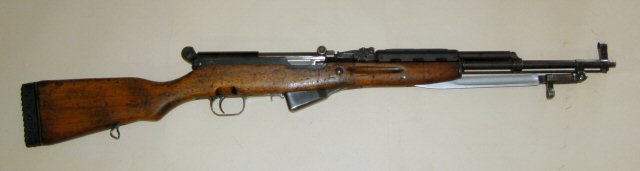
The SKS for 100-yard Highpower? A Reminder of California Before the Bullet Button AR-15's


The U.S. Service Rifle M-16 and it's commercial AR-15 spawn are arguably the single series rifles that most fits the intent of promoting good standards for a "well regulated" citizenry.  So much so that it was mentioned as such during the Supreme Court's deliberations on the subject by Justice Ginsberg.  It has rightfully become the most popular rifle in the country.  It has become as ubiquitous as the bolt-action rifle that revolutionized all aspects of firearms use at the beginning of the 20th century.

The availability of California Legal variation of the M-16/AR-15 competition platform with legal 10-round fixed magazines that have "safety critical" bullet button technology incorporated into the modified lower receivers has made the State of California a competitive home for high-power competitors.  It allowed the California Grizzlies Junior Rifle Team to win the prestigious Infantry Trophy at Camp Perry, something not done by a civilian team in decades and never by a junior team in the history of national competition since it was established following the report to Congress by President Theodore Roosevelt in 1903 on the need to promote rifle practice due to the sorry state of American marksmanship in the Spanish-American War.

Still, the 2012 variations of the California adapted AR-15's, while usable for competition and recreational shooting, remain tactically clumsy in comparison to the standard versions of the genre available to most citizens of the United States of America.  Any real expert in firearms knows this.   Anyone who does not reveals only how little they know about guns.

What follows is an old article originally penned in 2006 from the days before the "bullet button" existed. The objective of the project was to set up a high-power competition training rifle that could be used by a shooter still sensitive to the M-1 Garand.  It was a gun limited to 100-yard reduced range events, a woeful coping strategy at best to explore a field of competition that is one of the apexes of the rights of citizenship.   The need at the time was particularly acute for a junior training in California where it remains illegal for a minor to even handle a California statutory registered assault weapon.


A Desperate Shooting Project:
Improving the SKS for 100-yard Reduced Course Competition

Picture
The SKS rifle is an excellent rugged rifle capable of remarkable shooting accuracy but it suffers from deficiencies that detract from it's potential in its original military use designed configuration.

HERE's THE FLAW: The SKS rear sight design suffers from a too short sight radius that amplifies elevation errors in the sight picture but more important it wobbles from side-to -side several MOA under light finger pressure. The randomness is at typically greater than 6 to 8 MOA, larger than the bullseye of an NRA SR target.  So much for windage repeatability. The gun actually shoots where the sights point. It's where the sights are pointing that changes from shot to shot.

The gun was intended for delivering fire employed by soldiers on the move where such drawbacks are not of great concern. For target shooting however, something rock steady with the longest possible sight radius is called for.

Picture

A company named Tech-Sights www.tech-sights.com makes a sight that seems to address this deficiency. The unit doubles the sight radius and zeros the side-to-side play of the rear sight. It also sets up an aperture rear which is a much better sight for precision shooting. Elevation zero is done by adusting the front sight. No wind zero can be done by setting the rear to mechanical center and adjusting the SKS front sight to center the hits. Quite an improvement!

Tech-Sights also has an elevation adjustable rear version. Examined of it reveals that it is not useful for competitive purposes.   More useful would be a variation that uses the attachment approach of the sight onto the rifle but with the rear sight itself using M-16A2 sight parts.  That I would very much like to see.

Note: While Tech-Sights says it's optional to use the locking screw to tighten down the sight to the gun, it is in fact essential. It does shoot loose with predictable regularity unless this precaution is used. The rule of thumb to remember is that no manufacturer ever adds an extra piece of machined steel in the box unless there was a need for it.

Picture

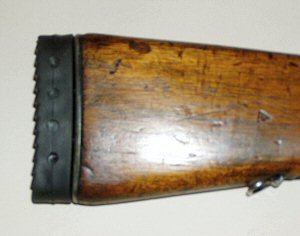
A rubber butt extension has been placed on the rifle to provide more appropriate eye positioning with respect to the new rear sight. It makes a big difference and should be considered essential. And it's much cheaper than any aftermarket stock.

I have experimented with various aftermarket stocks for the SKS; specifically, the ATI Monte Carlo stock and the Choate Sporter stock. The ATI is quite solid but the cheekpiece is set up for scoped rifles and does not work well with the TS100 sights. This stock seems better suited for a forward mounted optic project but that's not what we are working towards here.

The Choate stock is made from thin material, flexes in your hand and the action moves around in the stock. These are not ideal for a target gun. The stock does however have a very nice hand grip compared to the military stock particularly for providing better purchase for the ring and pinky fingers to grab. It has potential for exploring adding a cross bolt and bedding compounds to tighten the bedding of the action.

In the end there is a strong case to choose to continue to use the original military stock. The reason is because of the cross bolt in the military stock that creates a solid bedding for the rifle. It wedges the barrel at the action/barrel junction and in combination with the clamping action of the trigger assembly and recoil lug at the rear of the action provides two points of solid contact for the action. The barrel then free floats forward of the cross bolt. It's both solid and rugged.  Neither of the aftermarket SKS stocks tested afforded this superior bedding method. So for target rifle purposes, stick with the better bedding solution.

For match shooting be sure to lighten the barrel mass by removing excess metal objects like the bayonet. Also, there needs to be a sling mount point on the fore end for the sitting and prone positions. Using the mount point on the barrel defeats the whole purpose of the exercise.

Results

With the new sights in the military stock the gun now shoots in the 1" to 2" range at 100-yards using surplus ammunition. That is plenty good enough for club level competitions.

Using stripper clips, the rifle can perform well in the rapid fire stages of a highpower match.

Elevation adjustments are workable and repeatable using an SKS sight tool to adjust the front sight in a manner rather similar to using an M-16A1 sight system. Interestingly, because the SKS front sight is a continuous screw instead of a detent like the M-16 design, even finer adjustments are possible.

The training system is limited to fixed distance reduced course work but it should work well enough for either 100-yd or 200-yd training matches.

Bottom line.  This is not a substitute for a properly tuned match grade AR-15 with a 1-7/1-8 twist free floated barrel firing match quality ammunition.  The reality remains that you still need a real "competition rifle" to be anything respectable in this segment of the shooting sports.

Wednesday, June 13, 2012

A Correct AJP 4/47 Target Sight for a .303 British SMLE No.4 Mk1

The Lee-Enfield rifle has fascinated me ever since I bought my first Savage No.4 Mk1* in the 1970's  I picked it out of a drum at a gun shop.  The "U.S. Property" stamp indicating it had once been a World War II Lend-Lease rifle spoke deeply to a young man who grew up hearing the echoes of that war in the Fisher Wounds that lingered in my parents and grandparents.

As I took up the sport of U.S. style high-power rifle competition learning first with a Springfield Armory M1A back in the day they were still made from surplus TRW parts and later with the rapidly evolving AR-15 Service Rifle, I would turn back to the Lee-Enfield and wonder about how it fit into the grander scheme of things.  There were books but these were merely remote curiosities.  The advent of the internet and the connectivity it enabled across the planet beginning in the late 1990's changed all of that.  Suddenly, these ideas and these parts were no longer so remote.

Originally written 9/7/2005.

Picture
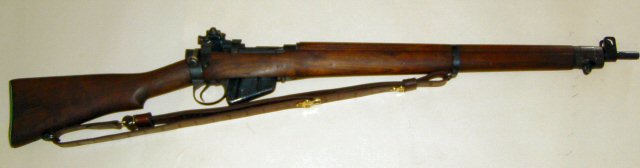
The Lee-Enfield No.4 Mk1 set up for target shooting with an AJP 4/47 micrometer rear sight, a tuned Huber trigger and a U.S. rifle sling.  This one has an unusually accurate barrel.  It loves 174 gr. Sierra Mach Kings.
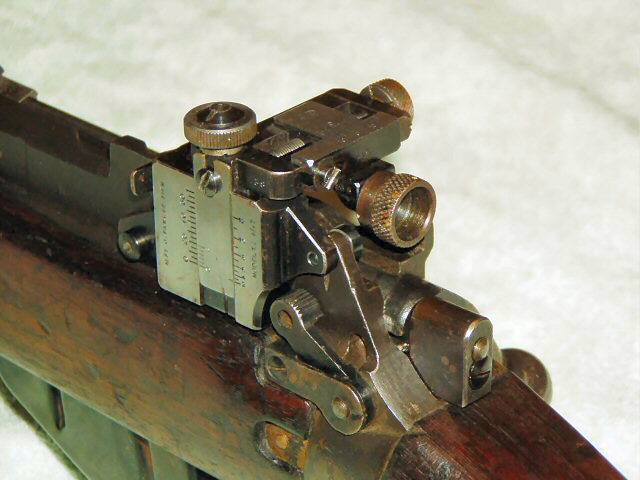
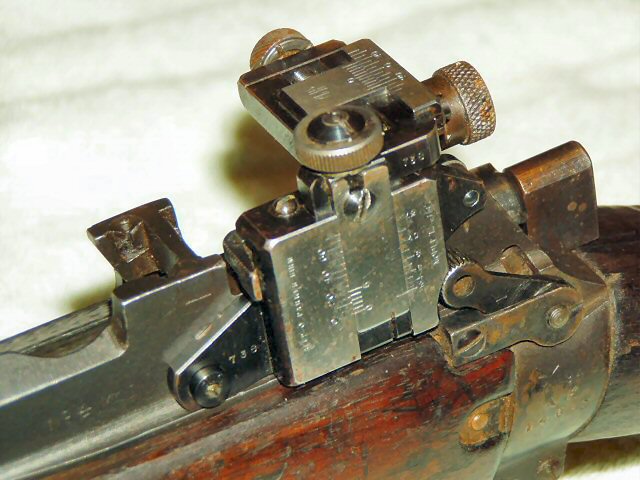
I've been hunting for an AJP 4/47 rear sight with the markings calibrated for the Mk VII .303 cartridge since 1977. You see other AJP 4/47's calibrated for the later L42 rifles in 7.62x51mm NATO but the truly correct sight is the early example made for the .303's These sights are intricate examples of precision machining now sadly found only in the most expensive of Olympic target sights. Patience and the internet have yielded the Holy Grail at long last. Thank you Andrew in New Zealand!

Picture
A.J. Parker 4/47 sight.

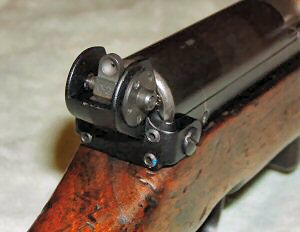
This view shows the replacement ejector screw which is longer than the original. Notice the hex head. They are made by Scott Stonehill at Evans Obsolete Screws in Evans, GA (706)863-7572, sstonehill@knology.net.

Picture
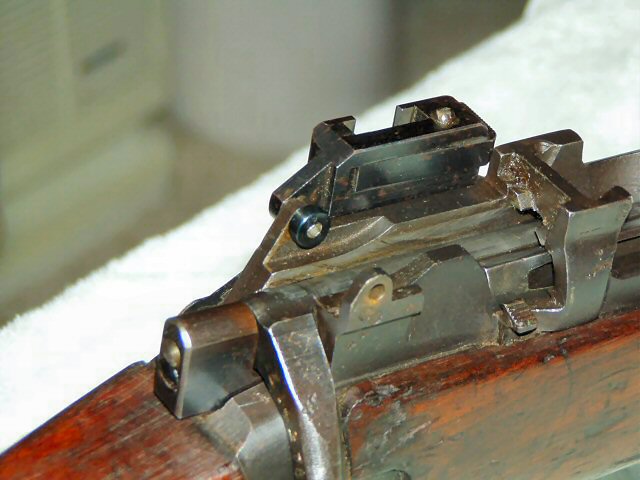
This is a no-modifications mounted sight.  After tapping out the issue rear sight and removing the original ejector screw, the AJP 4/47 is attached to the rifle.  This view shows the replacement ejector screw on the left side of the rifle.
This view shows the other hex head mounting screw for the sight. The AJP 4/47 requires no modifications to the rifle. Simply remove the original sight, in this case it was an L-flip late model rear sight, and install the target sight in the existing holes.

Picture
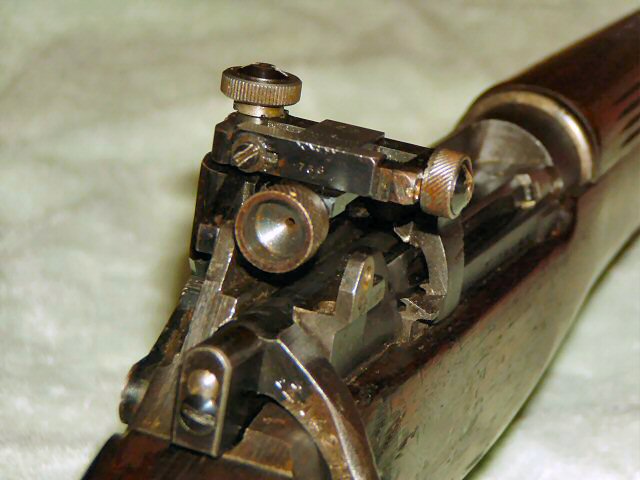
This view shows the attachment screw on the right side of the rifle.  Note that these screws use a British pitch which is why one goes to Scott Stonehill for the parts.
All set up and ready to sight in once some 174 gr. HPBT can be assembled. This rifle should make quite the splash when it shows up at a long range high-power competition line.

Picture
The AJP 4/47 is 1/2 x 1/2 MOA micrometer sight that is no slouch compared even to current generation high-end Centra or Phoenix match sights.  The dial precisely and repeatably. 
Providence sometimes smiles.  For a Big 5 Sporting Goods special, it has a bright shiny bore and the barrel floats perfectly out of the middle of its sturdy military stock. I actually bought this gun on a whim. I was shopping for gym socks.  I felt something special when I picked it up.  Good guns have a certain tightness and resonance you can just feel.

Picture
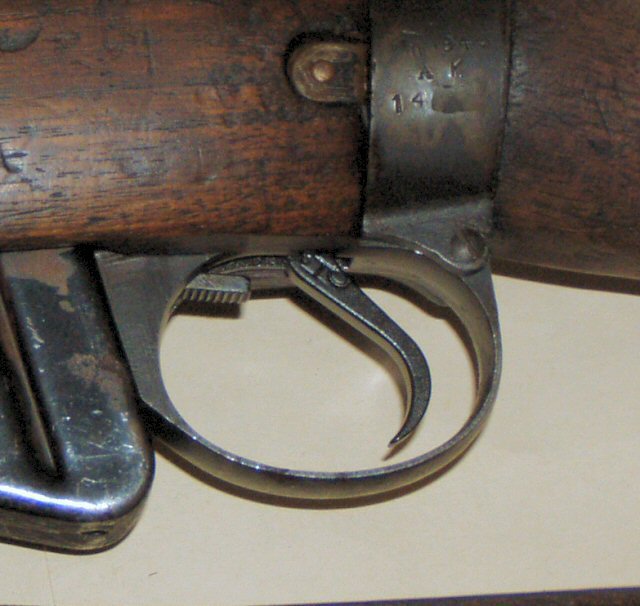
The Huber trigger can be adjusted to give an excellent crisp single stage break for target shooting.
The ball bearing target trigger installed in the rifle. The trigger remains a single stage system using the original sear and cocking piece. Sear engagement is set for 0.015 or better. This trigger is smooth as silk and breaks like glass. It performed with excellence at 1000-yards shooting surplus Mk VII ammunition on 9/4/05.

Epilogue

7/2014 - In the years since this article I have shot this gun many times.  It has performed admirably at club matches and I've done the Mad Minute with it a few times.  Drives like a dream.

Sunday, November 29, 2009

Swan song for a Colt 1-7 H-BAR barrel

Almost 20 years ago I bought a Colt Sporter H-BAR. This rifle hasn't been a closet queen. It's been my learning curve companion in the sport of high power rifle competition having been turned into a beautiful Frankenstein over the years with 1/4 x 1/4 sights, numerous better triggers, free float tubes and replacement barrels.

But the real heart of any gun is it's barrel. Everything else is just accessories hung around the tube. I took the original 5.56x45mm NATO chrome lined 1-7 barrel off several years ago dropping a DPMS 1-8 SST into the upper at the time. The original tube was at 4,500 rounds old at the time and it had been sitting in the spare parts box.

At the beginning of 2009, Daniel Defense came out with their Omega free floating forearms and I had a yen to build something approximating an Army SDM rifle so I took the old Colt 1-7 out and mounted it in an A3 upper. There was a good feeling taking the barrel that had accompanied me to the edge of NRA Expert classification and seeing it pushing pills downrange again. The assembly performed well with a 4X ACOG against tactical size targets. It still tries to shoot everything into the 10-ring which is about 2 MOA across.

And therein now is my woe. I decided to try shooting the next tactical match using this rifle. I'm learning more about it's quirks. The latest one is that one really probably should not clamp the optic base forward of the main action picatinny rail even though there are plenty of additional spots on the free floating forearm. But I'm still worried that the groups will stay opened up. While perfectly serviceable, if the barrel is worn out and no longer X-ring quality I'm going to have to retire the barrel again for good.

I'm up against my peers firing sub-MOA target rifles and I may need to swap to a new barrel that will print a pattern half the size of what this thing is doing now. Basically, all shots have to go into a Post-It note at 200 yards to be competitive. The issue is currently in doubt.

9 volt batteries: The chronograph is everyone's friend.

This is the year I really started to use my chronograph for more detailed load development. They work really well as one tries to replicate the ballistics of one good load using different propellants and primes. The shortage of components for most of 2009 makes you have to work a little more.

So the thing about my chronograph is that it eats 9 volt batteries. I also discovered that 9 bolt batteries are like communal food on a firing line because everyone else's chronograph also eats 9 volt batteries. I have yet to run one of my batteries all the way down. They all seem to get fed to my friend's machines before that happens.

Monday, September 14, 2009

Tactical Matches

For those of us that didn't go to Camp Perry for the Nationals, we held a tactical match. It was a fun change of pace.

Herman and I teamed up and had lots of fun. This is us firing simultaneously on targets at 300 yards. Herman is shooting a Remington 700 with a Leupold scope and I'm shooting an M1A installed in a Sage Mk14 EBR stock with a Bushnell 3200 10X mil-dot scope.

The targets are a collection of little colored shapes around 6 to 8 inches in size on a frame 300 yards away. They come up out of the target pits. The range officer gives you a color or shape. And the two of you have 10 seconds to get your act together and fire on exactly the same shape before it's wifthrawn.
It'd still been more fun to have gone to Camp Perry.

CMP Games 2009 Preparation Notes

Gun Notes

Took the M-1 Garand, M1093A3 Springfield and Enfield No.4Mk1* to the range. Got them dialed in with good zeros at 200 yards.

The Springfield still makes the most amazingly small groups and my notes match the old notations about the tip of the front sight being slanted. Got a better picture for managing that in this pidgeon's little brain. LOL.

The Garand groups were bigger than I liked. It was making touching holes in the X for me when I tested it on the 100 yard range on Saturday but only 10 ring patterns on Sunday. Remembered on the way home that As-Issued Garands have aircraft carrier wide front sight blades. Need to line up on the center of the post. Found the old notes about making a pencil mark in my notes. Will do.

The Enfield rang around a 10 ring group. Was able to improve it by noticing that the rear aperture hole is bigger in the Enfield. Larger than the optically indifferent diameter of a target aperture. That means one has to put a little more attention to centering the front post in it to get it to shoot tighter. That should get me deeper into the 10 ring with this gun. It's pushing Sierra 174gr Match Kings over a moderate charge of H4895. Will have to run them over a chrono to make sure the SD's are happy.

More "to do's" with guns,

1. Need to take the M-1 Carbine out and shoot a refresher with it.

2. Need to decide if I want to work up a load for 80grs under either N540 or Varget instead of H4895 for the Creedmoor Cup.

Eyes notes (more precisely shooting eyeglass notes),

1. Move the glass frames so that the view is through the center vertical axis of the lens to take maximum advantage of the way the progressive lens is cut. Gets the best image clarity on the front sight.

2. It's critical to change the rotation of the lens slightly for CMP shooting. It's because of the shape of the stocks. Correct lens rotation is about 5-10 degrees further over in head position tilt versus where the lens should be for working with the AR-15. Plan to set it one way for the CMP phase AND MAKE SURE TO FIDDDLE WITH AND RESET IT AT 200 YARDS on Wednesday for the AR-15 before beginning the Creedmoor Cup phase.

3. When in doubt go for contrast. The yellow filter works best. No filter is very clear but more susceptible to light changes. The gray filter gets the eye more open but that seems to work against the objective of smallest apertures = sharpest views.

"If you can't see, you can't win."

Sunday, September 13, 2009

CMP .22 Sporter Strategies

The 2009 CMP Western Games are coming. This year they are again holding a .22 Sporter match. This is a really fun event involving six stages of fire. Prone, sitting, offhand. Slow and Rapid for each. One must use a sporter type .22 LR rifle, no target guns allowed.

Last year I shot this match with a Ruger 10/22 equipped with a Tech-Sights aperture and post sight emulating the sights of an AR-15. It had a sling which helped immensely. However I made the mistake of using cheap Remington plinker ammunition and had a couple of misfires.

So this year I started searching for other ways to do this. The weakest part of the 10/22 solution was the trigger. Ruger factory triggers run around 8+ pounds with hard and gritty feelings. Yuck! The rules say 3 lb minimum weigth.

The other thing I noticed is that the guys with scopes had an advantage over my shooting in the same T-class. Scopes and aperture sights count as the same to the CMP. The maximum scope power allowed is 6X.

Option #1 presented itself at last years CMP Games in the form of surplus Mossberg M44US trainer rifles they were selling for mere $175 apiece. Naturally practically everyone there picked one up and yes they are great rifles. You did have to scrounge around for a new plastic trigger guard and a couple of magazines. They are old WWII era rifles and the old plastic had become brittle but there are vendors out there that specialize in parts for these old guns. I enjoy shooting mine immensely. This is defintely an improvement over the Ruger 10/22 for an aperture sights solution.

Next came exploring a scope solution. First came a BSA Platinum 6-24X target scope. This one had 1/8th MOA turrets and a mildot reticle. I initially mounted it on a Ruger 10/22. The trigger was still too harsh though so I put a better trigger in it. Alas, the improved trigger runs 2.75 lbs and I have no idea what one does to manage trigger pull weight on a 10/22. They have double spring sears similar to the FN/FAL. The 10/22 is a really nice gun now but doesn't make the grade for CMP competition. So abandon ship on that thought. I did put an email question in to Timney regarding their new 10/22 trigger asking if it can be adjusted to a 3 lb weight easily. Theirs, like most sporting triggers these days, is also factory set to 2.5 lbs.

Ok so third times the charm. Took a Marlin 25N bolt gun. Replaced the factory trigger with a Rifle Basix unit set to 3 lbs. Took the BSA scope off the Ruger and, after putting some Weaver bases on top of the dovetail to raise the scope so it's objective bell clears the barrel, put the 6-24X on the Marlin. Got sling swivels on it and off to the range.

50 yards. Bricks of Federal High Velocity Target ammo and Wolf Match Target. Both good ammo. Tested at 50 yards on the CMP Sporter target. Once sighted in it's clearly the slower and steadier Wolf ammo for this gun. Makes nice 1/4" groups at 50 yards.

Offhand test. 6X scope makes patterns bigger than I'd like at 50 yards shooting from the standing position. Wobble all over the place. Is it too much optical power or is it technigue?

Back to town. Midweek trip to the local indoor range. Offhand again. This time it's better. 50 foot offhand 50 shot group running about 1 1/2". That'll do. Need to practice to hone the technique. Fortunately it's indoor work and I love chewing out the center of a piece of paper with a smallbore gun.

I'm feeling more comfortable about Phoenix next month.

Remington 788: Another Evolving Story

Updated: 11/13/2014


Leatherwood A.R.T. scopes turn out to be pretty cool things. They are very fast to move for range adjustment and I do look forward to experimenting with the one I have more. But it does have some drawbacks.

Most important is that it's a single point solution. Setting the cam is specific to the rifle, cartridge, bullet, powder charge, optic, altitude combination. You can set it up well enough but you need to stay with that combination. Not so good if one wants to be able to switch more adeptly to say shoot different bullet weights.

Less important for hunting and tactical but critical for competition is that it's a 2-3 MOA rapid dialing solution. Just like tactical 1E/0.5W turrets, it's too gross for competing where precision and repeatability needs to be in the /18 to 1/4 MOA region.

So for my trusty Remington 788 the A.R.T. must come off. It'll be replaced by one of the best scopes I've found recently. A Bushnell 3200 Elite 10x40M. This is a 10 power mil-dot scope with 80 inches of elevation range and dead on repeatable 1/4 x 1/4 MOA turrets. They're rated for .375 H&H's and the image quality is excellent. The best part is they cost $200. They're an amazing deal.


Turns out modernizing Remington 788's is a quite popular. The guns been out of production for 0ver 20 years but there's a brisk business in Timney triggers for these guns and EGW makes 20 MOA Picatinny rails for them. How cool is that?

With a 20MOA mount and an 80MOA elevation range scope, reaching out to 1,000 yards will well within the dialing range of the system. Repeatable 1/4 MOA target knobs means one can change ammo, get a zero at any distance, and use the ballistics for that round to go back and forth from there. Optical range estimation is done the modern way using the mil-dot reticle. This will be much more very flexible. And so that's the direction this rifle will take next.

It does require more pencil pushing to stay ahead of the shot though and I still have to say the A.R.T. scope really is an elegant piece of firearms design.


Saturday, September 05, 2009

A.R.T. Camputer Scopes

Am pondering the pluses and minuses of the Leatherwood A.R.T. scope concept. Put one on a Remington 788 with a Timney 2lb trigger. That is one really good rifle. Shot it with a Leatherwood today going after small to medium targets at 200, 300, 600 and 650 yards. It's very fast to shift ranges and certainly well suited for it's original intended task of sniping against people sized targets. It's somewhat trickier against smaller targets.

Am learning that at least for now there is some offsetting involved. Zero at 200 and 300 is at 325 on the range ring but 600 is at 475 on the ring and 650 is at 550. Clearly I have got more to learn about correctly matching the eccentric cam to the round ballistics. I'll keep working with it.

This means that for smaller 1 to 2 MOA targets this type of scope is a compromise just like the 1E/0.5W fast turret scopes.

Right now I have a feeling the good old 10X fixed power Mildot scope with 1/4 MOA target turrets has the advantage for small target work.

Saturday, January 10, 2009

Time for New Eyes

2008 was one of those watershed years. I turned 50. You feel it most in your eyes. It gets harder to see that front sight well enough despite all the tricks you'd been using up to that point. I dropped an average of 15 points and really had to reevaluate things. Fortunately, one quickly finds out while bantering in the pits that a lot of other people have the same issue.

So on the the shooting eyes makeover. The contact lenses to correct astigmatism plus Bob Jones lens inserts weren't cutting it anymore. My shooting position and technique have actually been getting better. My wind calling is getting better too but I do need to find more ranges to shoot at on a regular basis that have real cross winds at 600 yards. My offhand technique in particular is on the up and I'm very pleased, holding and breaking 10's is coming a lot easier. Even my sling technique has improved.

But the blink-to-blink movement of the contact lenses was still making it so my shot groups orbited the X-ring instead of going into it. The guns and ammo were capable. The tiny movement as the soft lenses move was just making it so that it looks the same but the physical alignment is different. I didn't make my goals at the CMP Western and Creedmoor Cup in 2008. Got my share of medals? Yes. Shot to my competitive potential? No way. But I learned enough to know what had to come next.

So back to California and a phone call to my optometrist to set up an extended visit to talk about my eyes options. We talked all the options ranging from glasses to laser surgery. We talked about the need to have a system flexible enough to work with both As-Issued rifles like the M-1 Garand, Springfield and Carbine as well as the AR-15 Service Rifles, each gun has a different sight radius. Turned out that laser work would correct astigmatism but the optimization of focus would still require a lens. The decision was better to put off eye surgery and go with a solution that puts everthing into an eyeglass lens. And the technology for that was pretty neat. It's a progressive lens cut with an arc that allows for image quality retention with some tilting. The lens is mounted in a specialized Jaggi shooting glass frame which allows it to be repositioned at will on the firing line including locating the lens at the correct position in the progressive cut for the specific rifle's sight radius being used. And by tilting down a smidge still be able to clearly confirm the number board. (I do so hate cross firing.)

Experiments so far have been good. I got the glasses just in time to shot the regional matches at Twentynine Palms a month later and the 15 points lost in 2008 came back right off the bat. I'm back to shooting my averages. Continued experimentation practicing with a .22LR indoors shows I can focus even more on the front sight in offhand and that's good stuff. Have only had one chance to practice with an As-Issued M-1 using the lens in prone; but a significantly increased number of holes are definitely happening inside the X-ring.

So we'll see what the 2009 season brings. I'm looking forward to getting back on track woking on cleaning my rapid fire stages.